
More of the buyer journey is becoming invisible
Increasingly, the “classic” funnel is hidden. An estimated 70–75% of the buying journey now takes place outside marketers’ view. Buyers research through zero-click search, AI answer engines and private communities, often without ever visiting a brand’s website.
This creates two problems felt acutely by marketing organizations. The first is reaching the buyer: when questions are answered inside an AI model, brands must pivot strategies away from traditional SEO techniques to be included in LLM (large language model) citations. The second is reading intent. Take this example: someone discovers a brand with AI and eventually purchases later. The influence did happen, but no one ever saw it.
The stakes are particularly high in B2B, where chunkier deal sizes and complex buying groups already make the path to purchase difficult to trace. B2B buying group members are increasingly conducting more of the buying process “inside” answer engines, before sales or marketing knows an account is considering a purchase.
As historic sources of buyer journey and intent data are vanishing due to the use of these models, the signal marketers can observe at the tip of the iceberg is a shrinking share of total buying activity. The challenge is to understand what is influencing buyers when much of their research leaves no identifiable trace.
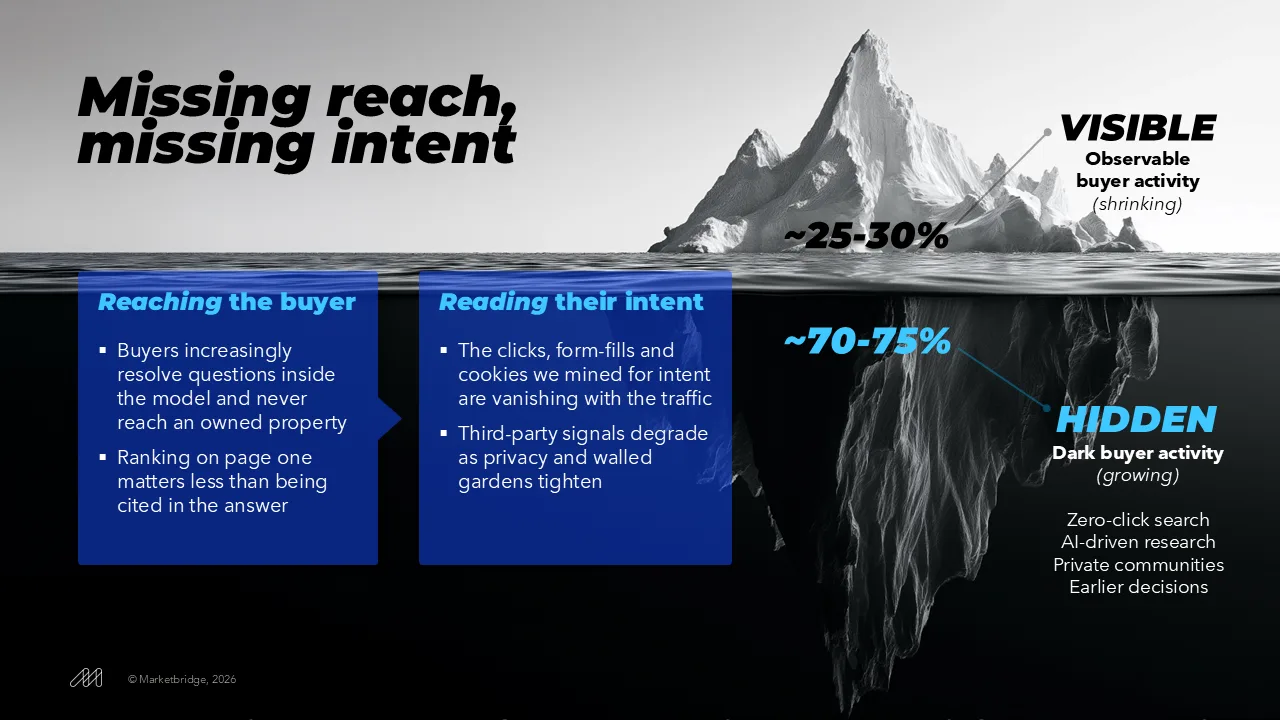
Future marketing measurement solutions must find durable indicators of interest and preference and account for marketing’s influence where individual interactions cannot be tracked. We also need to become more comfortable with “not knowing,” a departure from the measure-everything-at-all-times mindset that dominated marketing in the pre-LLM digital world.
What is driving hidden buyer activity
LLMs are usurping traditional search
The rapid adoption of LLMs has changed how people search. AI overviews are embedded in traditional search engines, and over 65% of Google searches now end without a click. Both B2B and B2C buyers also use AI chat tools for direct research. A presenter at the 2026 Forrester B2B Summit suggested these changes have contributed to a 30% drop in organic traffic since broad LLM adoption began.
Content is becoming increasingly ungated
Businesses are increasingly dropping gated forms, making content freely available to reach broader audiences and improve their chances of appearing in AI-generated answers. That can support answer engine optimization (AEO), but it also obscures buying signals from a domain that once provided reliable buyer information and insight into how content influences purchasing and intent.
Preferences form before buyers become visible
Buyers likely already have a favorite or “expected winner” by the time they contact sales or engage with a trackable channel. This does not necessarily mean the overall buying cycle is shorter. Rather, it means that more research and preference building are happening before marketers know an account is shopping. Waiting for identifiable intent signals may leave a brand outside the consideration set, a major disadvantage in a crowded marketplace.
More slop, less trust
An increasing share of content that once drove impressions is now low-quality, unmoderated LLM output. As this oversaturated landscape becomes harder to navigate, more buyers go straight to AI answer engines. The result is a cycle: “sloppy” content that might have once generated measurable impressions is instead aggregated by other AI models and served to buyers. Over time, this erodes trust in both the content that once supported buyer education and preference building and the answers AI engines provide. Together, these factors reduce engagement with the channels and content that traditionally produced observable buyer activity and impressions.
How marketing measurement needs to adapt
To solve for the emerging problem of hidden customer impressions in the age of AI, marketing measurement must evolve alongside the changing buyer journey. In the future, a unified measurement system allows marketers to have a more complete view of impact that includes both the observable and the hidden influences that are driven by AI sources and upper-funnel activity. A successfully unified system should continue to measure and optimize observable touchpoints where possible but also account for unknown signals probabilistically where more traditional forms of tracking may fall short.
As marketers and analysts, we must also become comfortable with ambiguity and embrace a certain degree of uncertainty. The structural changes in what we know about buyers that have resulted from AI adoption present an opportunity to find a middle ground for measuring marketing effectiveness that avoids the “measurement trap” or over-measurement, while still leveraging both old and new sources of data to inform our understanding of what works and what doesn’t. This addresses the symptomatic trends of hidden customer impressions while simultaneously allowing for a higher degree of comfort with uncertainty.
Align sales and marketing objectives
Another critical input to successful measurement as customer impression data decreases is to align sales and marketing objectives as closely as possible. Shared measurement techniques can ease the familiar GTM (go-to-market) tension between lead generation and closed deals by giving both teams a common view of performance. Using the information that remains, alongside econometric techniques to fill gaps, can help support ROI-informed decisions and assign credit to both sales and marketing activities. In a low-impressions environment, aligned objectives help organizations maximize results while reducing friction across orgs within the broader GTM motion.
Create and leverage systems that facilitate successful measurement
Because marketing serves multiple objectives, it needs multiple measurement approaches. Connected methodologies that “measure the system” become more useful as individual buyer interactions disappear from view. Customer-centric, probabilistic signals are more likely to succeed than purely deterministic measurement, helping marketers triangulate customer sentiment and attitudes, establish causality, and understand overall effectiveness as the customer impressions landscape continues to shift.
This starts with how marketing and sales data is collected and stored across the organization (see Beyond the CDP: Building a composable go-to-market data stack). Then leverage combined multi-faceted measurement approaches such as Unified Marketing Measurement (UMM).
An approach like this balances known and unknown customer impressions across the buying cycle while also aligning to relevant objectives (i.e., Preference, Sales, Trust) across different parts of the organization (i.e., Brand, Demand, CX) while helping leaders understand what’s working even with fewer visible signals in the face of uncertainty.
Practical responses to declining visibility
| What is changing | How marketers can respond |
|---|---|
| AI is changing search |
|
| Content is becoming increasingly ungated |
|
| Preferences form before visible engagement |
|
| With more slop, trust is harder to earn |
|
Make confident decisions with incomplete visibility
Hidden buyer activity does not remove the need to demonstrate marketing’s contribution. It calls for a broader evidence base and more explicit judgment about what the data can support. By connecting shared outcomes, integrated data and complementary methods, both B2B and B2C leaders can build a more useful view of growth and decide where their next investment should go.
For a practical framework to connect GTM activity, measure incremental contribution and guide investment, explore The Executive Guide to B2B GTM Measurement.