
B2B marketers have spent years adding intent platforms, automation, enrichment and analytics to their stacks. Despite these efforts, pipeline remains unpredictable in many organizations. The problem is often less about the volume of demand or the quality of the technology than the way the revenue system operates.
There are four gaps that repeatedly drain value from that system: signal, ownership, orchestration and visibility. Each can waste media investment and seller time on its own. Together, they create a more damaging pattern – marketing teams detect activity that sales cannot use, sales follows up without context, buyers receive disconnected messages, and leaders cannot see where progress stalled.
These issues first appear as channel problems such as weak conversion, slow follow-up, inconsistent account coverage, or a weak ABM platform, that often leads marketing teams to investigate another campaign or tool.
But before investing in more capabilities, go-to-market leaders should ensure they fully understand the connections between their current systems, processes and incentives. Closing one gap in isolation rarely solves the problem because it usually moves the leak farther down the funnel. Instead, revenue teams should address all four as parts of the same operating model.
1. Fixing the signal gap
Organizations have too many signals – intent data, website engagement, account activity, person-level advertising interactions and company news often sit in separate platforms. Sellers either receive the information too late or get a pile of alerts with no clear priority.
The first fix is simple: marketing, sales and revenue operations should document which signals matter. They need a shared definition of fit, the intent topics that indicate a genuine buying motion, the first-party behaviors that deserve attention and the business triggers that make outreach timely. Sending every content syndication response to sales, for example, is a quick way to erode confidence in marketing data.
Technology can then consolidate, clean and route the agreed signals. AI is useful here because it can connect activity across systems, identify patterns that resemble previous opportunities and surface relevant account news. But the output must lead to a recommended action, not another dashboard. Human review also remains important, particularly while a team is refining its model. Over time, closed-loop analysis should show which signals actually preceded opportunities and revenue, allowing the team to remove false positives.
2. Mending the ownership gap
The handoff between marketing and sales is one of the least-owned parts of the B2B revenue process. Marketing is measured on qualified leads while sales is judged on bookings, leaving no one accountable for what happens between those points.
Shared revenue goals change the conversation. Teams should agree on the accounts and buying groups they need to advance, the journey stages they will use, who acts at each stage and the service levels for doing so. Revenue operations can provide the connective tissue, but only if it has a mandate that spans marketing, sales and customer success. When RevOps functions mainly as sales operations, cross-functional priorities tend to lose out.
Large organizations should begin with a small cross-functional team rather than attempt an enterprise-wide rollout. A focused pilot with willing sales champions can establish the process, test the service levels and show whether account progression, meetings and pipeline improve. That evidence makes the eventual change easier to scale.
3. Filling the orchestration gap
A target account is not a single buyer moving neatly through a funnel. Different buying groups within the same company may be at different stages, and the people in each group need different information. An account-level strategy without person-level coverage therefore leaves a major blind spot.
Go-to-market teams should first define the buying group by role, function and influence, then assess whether their data covers those people. Campaigns can then match content, channels and offers to observed behavior. Early-stage buyers may need education about the business problem. Buyers comparing solutions may respond to case studies or expert briefings. Later-stage groups may warrant direct mail, an executive dinner or a consultative meeting offer.
Marketing teams should not switch off when an opportunity opens. Instead, they should support sales through the deal, while sales feeds account intelligence back into campaign decisions. Revenue and marketing operations need a seat at the planning table from the start so data capture, routing and triggers are designed with the campaign rather than bolted on afterward.
4. Closing the visibility gap
More dashboards do not automatically create visibility. Teams need a common view of performance across four areas: reach, response, revenue and reputation. Reach shows whether the available budget can cover the target market. Response tracks account and buying-group movement, rather than relying only on form fills and qualified leads. Revenue measures opportunities, win rate, deal value, stage conversion and time to close. Reputation indicators such as brand search, GEO visibility, customer reviews and social sentiment can offer an earlier view of future demand.
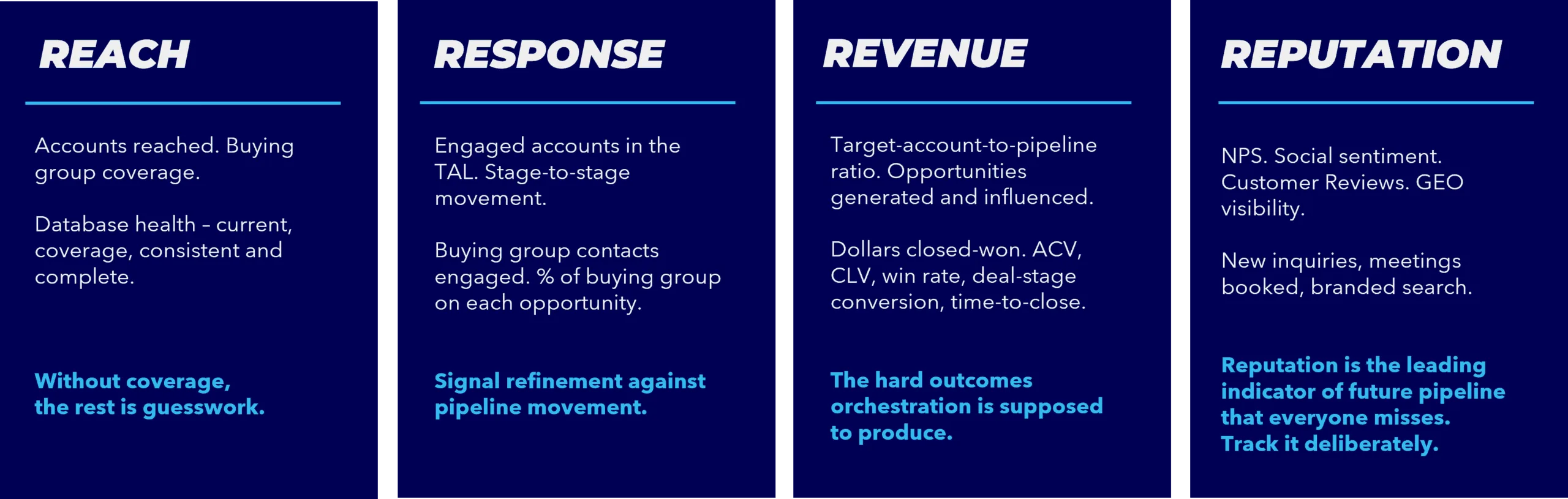
This balanced scorecard matters because B2B sales cycles may run for many months. A three-month pilot cannot always prove closed revenue, but it can show whether target accounts are engaging, buying-group coverage is improving and accounts are advancing. Teams should also work backward from the revenue target, average deal value and historical conversion rates to calculate the opportunities, reachable accounts and media investment required.
Predictable pipeline growth depends on treating these four gaps as parts of one connected operating system. Shared signals create a clear view of buyer intent, defined ownership turns insight into action, coordinated engagement supports the full buying group and consistent measurement reveals what is working. Together, these disciplines transform fragmented activity into a focused revenue engine built for sustainable growth.
Want to go deeper? Watch our recent webinar recording “Breaking down silos: How leading B2B orgs are orchestrating revenue” for a practical look at the strategies top B2B teams are using to improve alignment, strengthen handoffs, and turn fragmented go-to-market activity into more consistent revenue performance.