
Go-to-Market leaders see the AI landscape changing quickly. They are exposed to new tools and better models every day. And most react in two ways:
- Paralysis: Don’t know where to start so constantly in discovery mode and never moving forward
- Sprawl: Buy a tool, and hope it adds up to value
MIT’s Project Nanda research finds that 95% of organizations are seeing limited to no return on their generative AI investments. Those reacting with paralysis or sprawl end up in the 95% that don’t realize any value.
But what if your competitor is in the 5%? There’s real risk and opportunity costs if you don’t get AI right.
The AI maturity curve
So let’s talk about what separates the 95% of organizations seeing no return and the 5% that are.
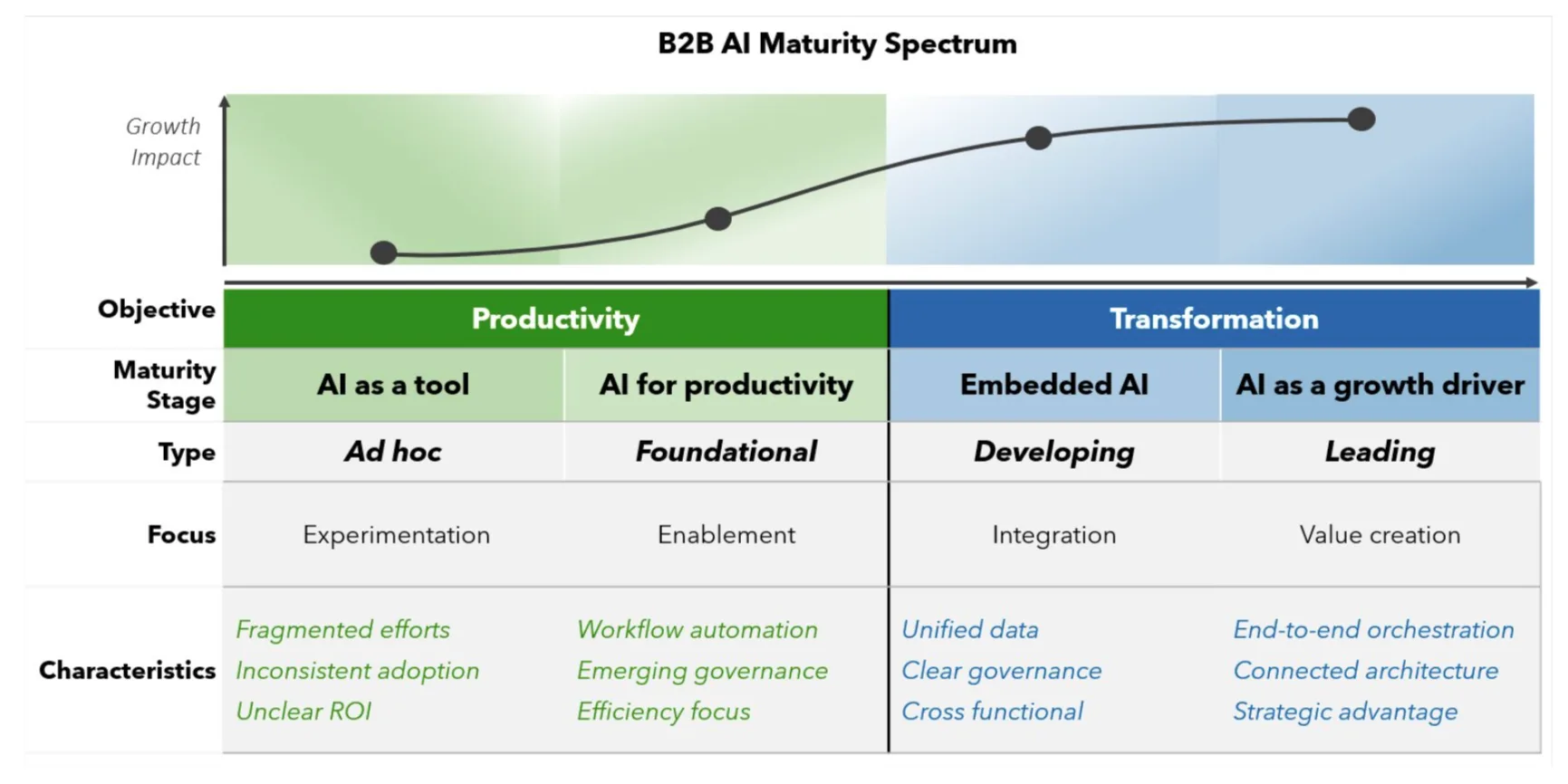
Based on our work with B2B enterprises, we’ve mapped the AI maturity curve across two objectives and four stages:
- AI as a tool: In this stage, AI is used for experimentation. Usage is ad hoc, adoption is inconsistent across the team or organization, and the ROI is unclear. This is where many orgs start—trying to increase productivity and automate.
- AI for productivity: The next stage is typically marked by more ownership and strategy. The focus is on driving internal efficiency. Workflows begin to be automated (though typically only within individual departments or teams) and governance for usage begins to emerge.
- Embedded AI: At this stage, the objective changes to transformation. These organizations have leadership buy-in and clear prioritization to enable cross-functional use cases. This phase is when required data lives in one place and clear, established governance is in place.
- AI as a growth driver: Leading organizations have reached this stage through end-to-end orchestration and connected architecture. AI isn’t just an investment, it’s creating value and providing an advantage because it’s embedded in the strategy.
Notice that the maturity curve isn’t linear—the jump between AI for productivity and embedded AI is significant. As Steven Lewis, Managing Director of Strategy & Consulting, notes in a recent webinar, “That’s the productivity-to-transformation threshold, and it’s where the real value lives.”
How do you make the leap? What are the 5% of organizations who realize real value from GenAI doing differently?
Moving from AI investment to scalable impact
The difference is a clear holistic strategy. Not just a strategy for rolling out a pilot or new tool. A strategy for how teams will work differently.
According to survey respondents in Pavilion’s April 2026 AI Pulse Report, the biggest barriers to scaling AI are clear ownership and strategy, lack of data and integrations, and lack of governance.
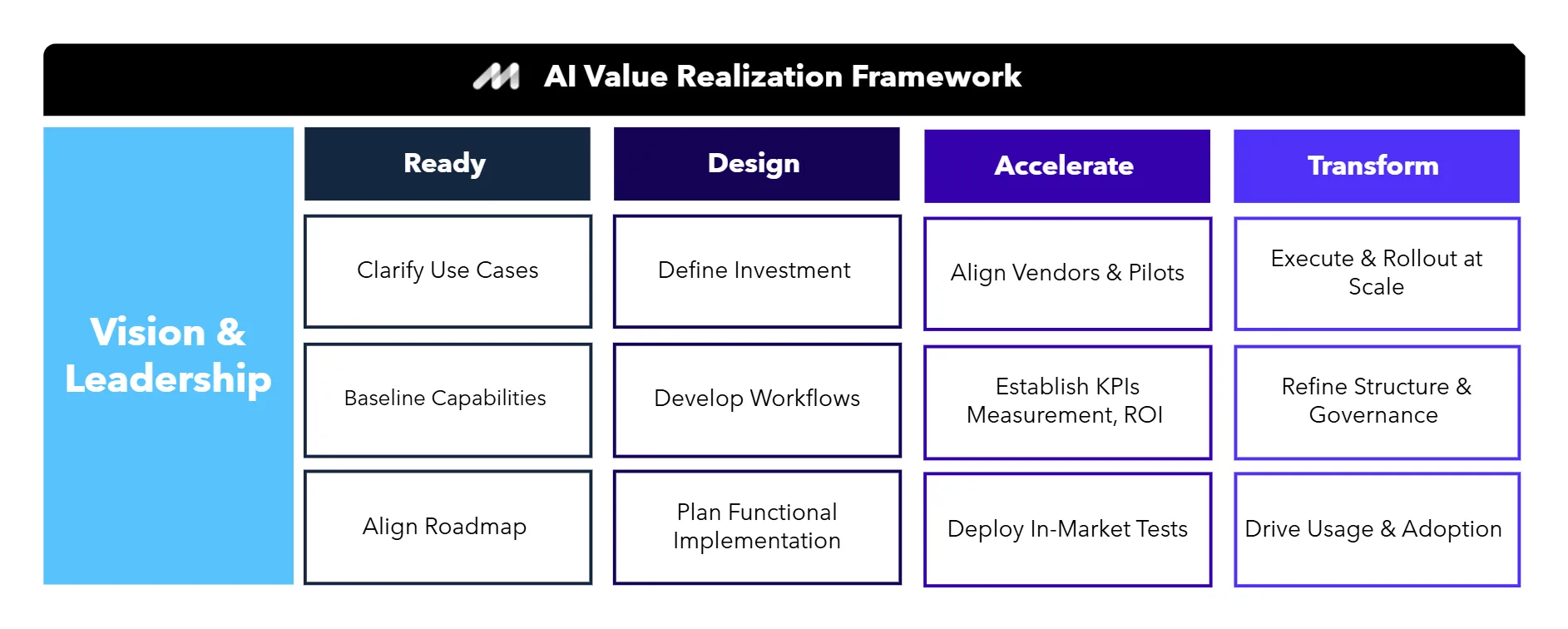
Our AI value realization framework has a foundation of vision and leadership and four phases: Ready, design, accelerate and transform.
Ready phase
Clarify use cases: Translate your organization’s AI opportunities into clear use cases with integration plans and data requirements. Most organizations fail because the use case is too broad (e.g., find growth or accelerate pipeline), or they jump directly to a tool.
Baseline capabilities: Evaluate how these use cases are getting done today. What is the current process, who is involved, and what are the implementation implications?
Align roadmap: Sequence the use cases based on data requirements and implementation needs. Consider the potential impact (revenue impact as well as internal time saved) when building the roadmap.
This phase builds the foundation of your strategy, enabling you to move faster on future use cases.
Design phase
Define investment: Outline investment available and required for the pilot. This may require scanning (or even talking to) vendors to understand costs, but don’t jump to moving forward with any vendors yet.
Develop workflows: Determine how existing workflows will change, what will be automated and where human judgment is required.
Plan functional implementation: Leverage the integration plan and baseline capabilities from the Ready phase to plan that actual implementation and data required.
Now you have designed what your organization needs and begun to establish a governance structure. Time to find vendors that fit that need.
Accelerate phase
Align vendors & pilots: Research the vendors that meet the defined needs and requirements.
Establish KPIs, measurement, ROI: Work with analytics to identify KPIs and develop a measurement plan for how to measure ROI on this AI investment. Organizations often skip this step and try to measure after the fact, but struggle if the data needs aren’t established prior to launch.
Deploy in-market tests: Launch the pilot. Monitor and document what issues come up and how processes change from what was planned—valuable information for the next use case.
Notice that this last deployment step is the first actual implementation step: that’s intentional. Though it feels like AI is moving so fast that you’re already behind, rushing an AI use case to market won’t drive long-term GTM efficiency or scalable impact. Strategy takes time so your implementations can move fast and evolve quickly.
Transform phase
Execute & rollout at scale: After documenting the issues and process changes, now you’re ready to roll out enterprise wide. Continue to monitor KPIs and document changes.
Refine structure & governance: Review the initial governance structure drafted in the Ready phase and evolve based on enterprise rollout.
Drive usage & adoption: Monitor usage and adoption across the key teams (hint, this should be part of your KPIs in the Accelerate phase) and identify ways to increase adoption.
Conclusion
If your organization established clear AI ownership and you’ve followed the steps above, you should be well on your way to embedded AI.
But if you’re worried that leadership isn’t aligned on the vision for AI, you want a clear-eyed external perspective and support to build your strategy, or you need help moving to maturity, we can help. Get in touch.
For more on the AI value gap and where (and why) AI fails, check out our recent webinar “Beyond Pilots: How to Bridge the AI Value Gap”.