
This article is Part 2 on B2B measurement. Check out Part 1: The problem with B2B measurement.
GTM executive summary
- B2B marketing organizations should leverage a Marketing Income Statement built off account-level multi-touch attribution and brand models to better communicate overall marketing ROI.
- Like a financial statement, the Marketing Income Statement uses standard dimensions that can be compared over time, and reports three different contributions: last touch, multi touch, and brand.
- This article is for Analytics and Revenue executives tired of internal infighting over sales vs. marketing credit, and technical CMOs who want to better communicate with finance.
Counterfactual part-worths
So what to do? Dumping the pipeline concept entirely has been proposed by some. An even more ambitious proposal might be to eliminate the marketing-sales distinction completely (there is in fact a trend toward the “Chief Revenue Officer” running the entire go-to-market function.) However, these ideas probably go too far, even if they have some merit. Instead, taking a counterfactual attribution approach that uses “part worths” rather than all-or-nothing “who drove what” rubric can put marketing and sales—and the channels within marketing—on level ground.
In this approach, it is acknowledged that any transaction is driven by multiple, complex factors over a long period of time. It is also acknowledged that, at scale, each part of the go-to-market mix has a “counterfactual impact”—if that part of the mix had not been used, ultimate revenue would have been lower. This is the right way to think about ROI: The “R” for return should be the de-duplicated, incremental return. No one else should take credit for it.
Of course, a large B2B transaction can’t be “half-won” any more than a cat can be half-dead. However, over many hundreds or thousands of deals, we should be able to say that, for example, had we not done events, we would not have seen 3% of the deals we ended up closing. That is the basic idea behind a counterfactual / part-worth approach to assessing marketing ROI.
Fortunately, to get this done, the pipeline—the cause of our problem—can come to the rescue. A pipeline is essentially a database. The discrete item, whether lead or opportunity, exists in time, changing its stage (probability), while encountering various stimuli (marketing or sales).
More broadly, that item is a member of an account. That account contains many people (contacts) who may be a part of the buying group influencing that member. We can’t be sure, but we can build statistical models to infer these relationships.
All of this is to say that a B2B organization can build an Account Longitudinal Record—everything we know about leads, opportunities, contacts, and stimulus at an account, over time, arranged row by row. Think of this as an account’s “go-to-market fingerprint.” This can include both the things we know (deterministically, i.e., with a database key) and the things we think might have happened (probabilistic touches, for example, that an account watched an online video that was targeted using an account-based marketing approach).
Account level multi-touch attribution
Fortunately, the techniques exist to understand how important different stimuli are in driving outcomes. Multi-touch attribution (MTA), a method first developed to understand how digital marketing touches drove an eventual ecommerce sale, can be expanded in scope to provide insight into B2B marketing effectiveness. The basic idea behind MTA is to understand how each touch in a chain of events contributes to ultimate success. To do this, “ones” (won deals, or opportunities, or sales accepted leads) and “zeros” (losses) are “backtracked” to understand what drove them. In each case, interventions at various points in the causal chain are assigned importances using statistical inference.
One critical point unique to B2B is the focal point of analysis: The account or buying group instead of the lead or opportunity. Many CMOs and CROs are arguing today on LinkedIn that “the pipeline is dead” and that “marketing should be done at the account level.” However, the reality is that martech and CRM systems still use a discrete object to track the progress of sales. It is unrealistic to think that this data structure is going to go away. So what to do?
The short answer is that leads should be thought of as indicators of engagement, instead of as objectives. For example, multiple leads might emerge out of an account, all of which might “partially convert” to an opportunity. The leads reflect the effectiveness of marketing being done, which might ultimately impact zero, one, or more opportunities.
By treating the lead-opportunity construct as a system rather than as a linear handoff, “CRM discipline” issues are also addressed. A common problem in tracing marketing’s impact on revenue is sales teams failing to convert leads, instead creating a new opportunity, and “losing the breadcrumb trail.” In a systems model, this problem becomes irrelevant. Instead, the lead and the opportunity are linked by inference, with the lead having predictive, driving power on the opportunity, but not a 1:1 linkage.
A simplified version of this attribution concept can be seen in Figure 1 below. In this example, revenue is attributed back through the mid- and lower-funnel. Marketing’s incremental impact is 11%, and sales’ is 22% (including some credit for ABM through the sales cycle).
Note that 67% of the win’s value is “base.” This might be the trickiest concept to communicate. Culturally, last-touch crediting remains king in B2B organizations, due to the sales-driven, make-or-break focus that is mandated by quarterly earnings reporting. In this model, whoever hands the lead off to sales gets credit—and blame, when the volume or quality of leads isn’t “up to snuff.” Typically, the entirety of a lead is credited to the last-touch marketing channel, and the entirety of the win is credited to the sales rep or partner who closes the deal. However, the reality is that usually most of the deal flow is caused by neither the immediate actions of marketing or sales—it would have happened anyway. However, over time and without care and feeding, this base will decay away to nothing. In one sense, the “base” of a marketing attribution model is the purest definition of brand equity.
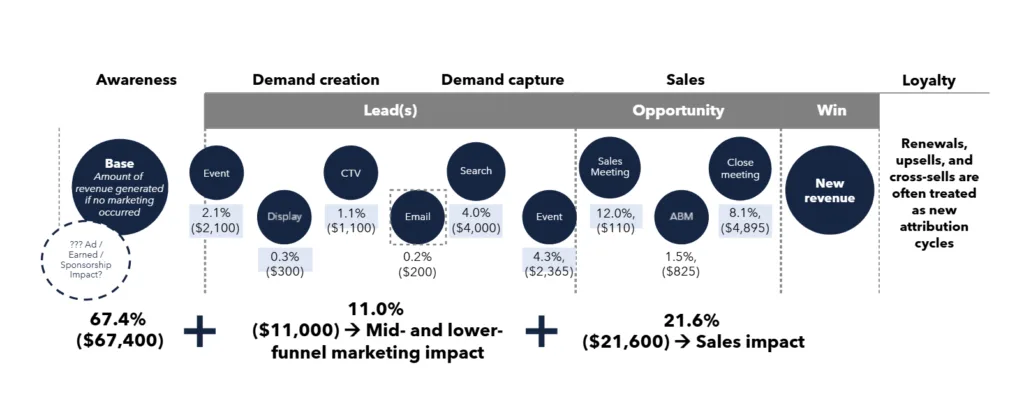
Figure 1: New revenue gets partially attributed. Note that brand equity is still a part of the base.
Measuring the value of upper-funnel and brand investments
The value of a B2B brand is huge. “No one ever got fired for buying IBM” has been a funny refrain since the 1970s (these days, it might be replaced by Microsoft or Adobe.) B2B buying decisions are large, complex, and have huge career implications for the executives making them. If a multi-million-dollar software purchase goes south, a senior executive is going to take the blame. The brand, then, is much more than a shiny logo and its associated feelings—it represents reputational security.
As in the consumer space, marketing has a role to play in driving B2B brand equity. Without “upper funnel” advertising, a B2B brand runs the risk of being seen as unserious, even if it is still known. CMOs intuitively know that a brand like SAP or Adobe needs to be in certain places—at the right conferences, the right airports, or the right sporting events. Presence signals financial health, much like a bird with brilliant feathers signals mating fitness: “I have so much extra energy, I can use it to impress you.”
Measuring brand equity and the investments that support it is hard. This is often where conversations break down between marketing and finance. CMOs spend a lot of energy playing the political games that allow them to spend money on sponsorships and brand-building activities. These investments are often supported by “vanity metrics”—visits to booths, number of executive eyeballs who saw the sign at the U.S. Open, etc.—but ultimately, most of these data are used as a drunk uses a lamppost: For support instead of illumination.
However, this does not have to be the case. A long-run brand value model can be run for B2B companies. This is an econometric model, similar to a traditional MMM (marketing mix model.) It can be run at a coarser time granularity than a traditional model; quarterly works well. The basic idea is establishing two causal linkages: First, between upper-funnel or “non-lead gen” marketing and brand equity; and secondly, between brand equity and revenue (or profit, or growth, depending on business objectives).
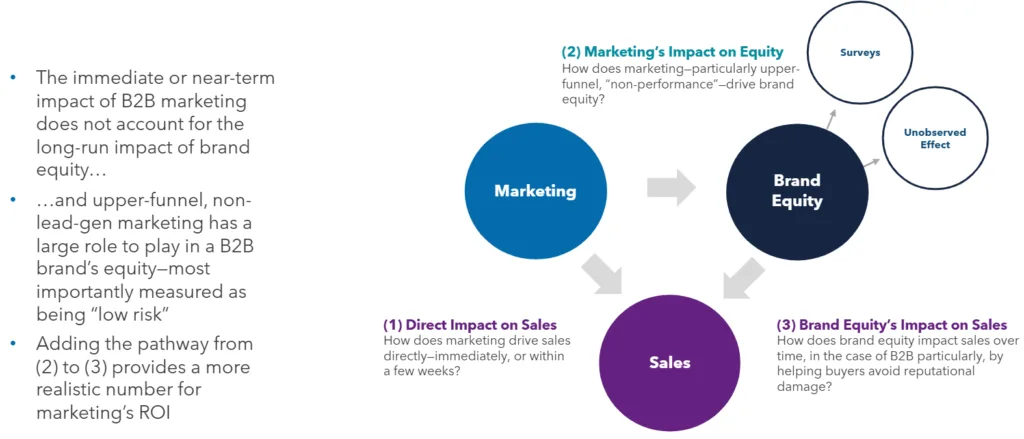
Figure 2: Measuring upper-funnel marketing by using brand equity as an intermediary. For B2B brands, having a “low risk” reputation is perhaps more important than being seen as innovative.
The trickiest part here is measuring brand equity over time. To work, a B2B brand really needs several years of data, measured quarterly, on the health of its brand. Brand health itself has to be measured indirectly. Social scientists use a tool called Structural Equation Modeling to understand which “manifest” (i.e. measurable) variables best describe an underlying construct—in this case, the value of the brand. This may sound like black magic, but it is a well-established technique. The good news is that by using multiple manifest variable to measure brand, a more stable and reliable estimate is available that is more usable in regression modeling.
Of course, marketing will not be the only, or even the largest, contributor to brand value. Product quality, competitive actions, word-of-mouth, and sales force interactions all work together to keep a brand strong. However, without marketing, brand struggles, and eventually, growth becomes impossible.
Combining the output from the account-based MTA with the output from the long-run brand regression model can provide what so far has been largely unattainable for B2B marketers: a complete understanding of marketing’s value, over both long- and short-time frames, across accounts, and pan-channel.
Communicating with a marketing income statement
All the data and statistics in the world are useless if the various stakeholders across the company do not have a clear understanding of marketing’s performance. Fortunately, financial reporting gives us a nice template that we can adapt for marketing—the income statement.
Income statements are useful because they tell us what was accomplished over a period. For example, in a typical quarter, I might have generated $50M of profit on a revenue of $500M. We can use the same basic concept for marketing.
There are some other principles that we can borrow from financial accounting. The first is that we can’t count anything twice, or, if we do, we need to be very clear about it. For example, if we are reporting marketing’s return by channel, then each channel added together can’t equal more than marketing’s total return.
The second is that we should use standard dimensions that don’t change (much) over time. In accounting, these dimensions are based on the structure of the General Ledger. The reason we do this in financial accounting is to compare trends to better understand what “good” looks like. Marketing reporting has a bad habit of constantly changing reporting dimensions, which makes it very hard to gain any real insight out of the numbers. So, our marketing income statement should be as stable as possible—and this has implications all the way down the marketing data stack. In fact, that account longitudinal record mentioned above functions much like the general ledger does in accounting.
The marketing income statement itself looks a lot like a financial income statement. In this example, each channel has three different kinds of contributions: last touch, multi touch, and brand. Brand contribution isn’t directly tied to leads or orders, but rather accrues to the “base”—the percentage of revenue that marketing doesn’t drive directly. In this case, marketing’s multi-touch effect is 21.5%—that is, counterfactually, if marketing had not been done, around 22% of sales wouldn’t have happened. The brand effect is also significant, at 4.8%, but that impact, while real, won’t be felt until future years and quarters. The total ROAS (return on ad spend) is $2.91, meaning that for every dollar spent on media, $2.91 of value is created.
Imagine that this is a view for a specific business unit, geography, and time period. Keeping this dimensionality consistent, along with the names and taxonomy of the channels themselves, provides marketers and executives with a clean, comparable performance diagnostic that can eliminate much of the drama around marketing effectiveness.
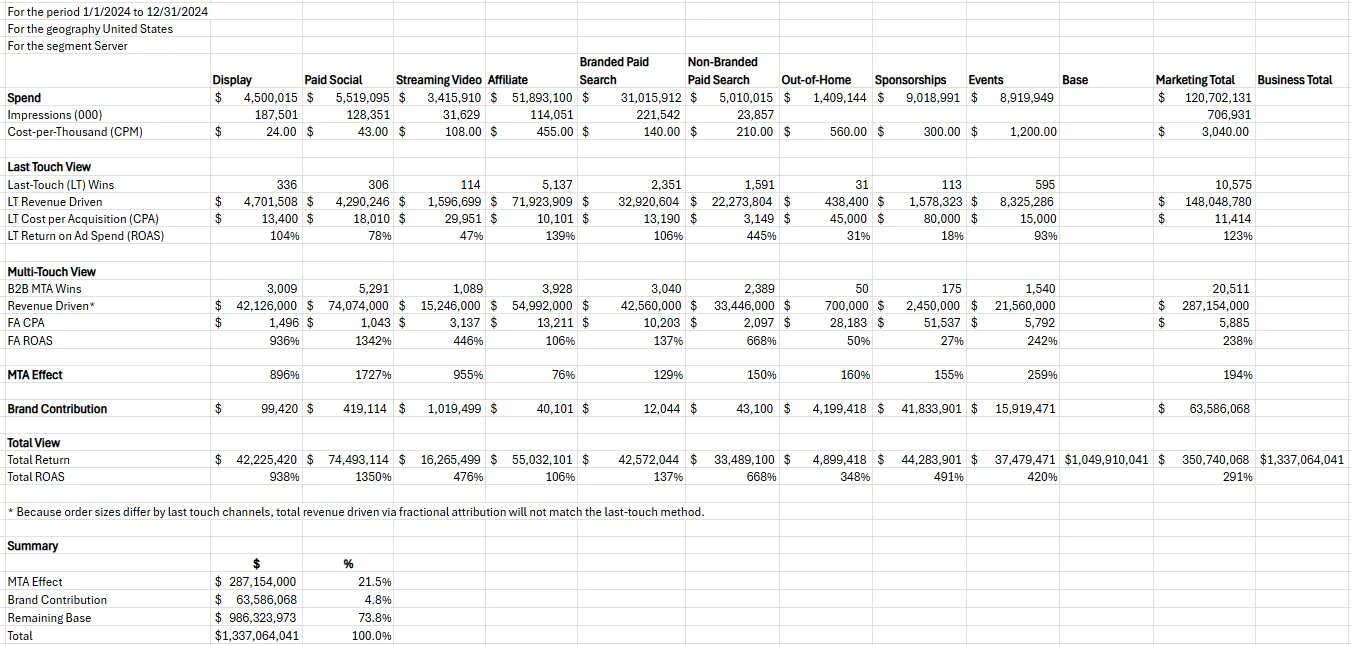
Figure 3: A B2B marketing income statement. In this case, each channel has a “last touch”, “multi touch”, and “brand” contribution. The brand contribution goes towards the base. For ease of illustration, it eats into the current period base, even though in reality it accrues to future periods.
Conclusion: Is measurement the key to ending the marketing vs. sales war?
At its root, sales and marketing don’t get along because they don’t believe each other. Or, more fairly, sales doesn’t believe marketing. They know on one level that they need them, but the actual dollars that they are driving are always in question in a zero-sum game of all-or-nothing credit.
This doesn’t have to be the case. By centering on a standard set of reports, with consistent dimensions, and taking into account both the multi-touch effects inside of accounts and the long-term impact on brand, sales and marketing can get to a point of common ground. Even if the data and analytics aren’t perfect right away, over time, consistency will win.
That consistency also will illuminate underperformance. Rather than playing the blame game when revenue targets are missed, the standard reporting mechanisms can show if marketing, sales or base is contributing less over time. Many B2B orgs don’t recognize the signs of under investment in upper-funnel until it’s too late. Better understanding the part-worths of every opportunity helps organizations work smarter and more efficiently together.