
For healthcare payers, growth is determined by more than just acquisition. It depends on what happens after enrollment.
Across health plans, PBMs, and integrated care organizations, sustainable growth depends less on winning the contract and more on whether members engage with care, adhere to treatment, navigate benefits effectively, and stay connected to the system over time.
The financial implications are significant. Nearly 90% of healthcare spending is tied to chronic and mental health conditions, while medication nonadherence alone costs the system an estimated $100B—$300B annually through avoidable utilization and worsening outcomes. At the same time, specialty medications now account for roughly half of total drug spending.
These are not simply clinical challenges. They are growth challenges.
Yet most commercial and operational models were built around acquisition and channel performance, not coordinated lifecycle engagement. Marketing, clinical, pharmacy, service, and care management teams often operate with disconnected data, workflows, and metrics, even though member outcomes depend on coordinated action across the lifecycle.
Revenue Orchestration in healthcare
The model must go further
Marketbridge has written extensively about how leading enterprises are orchestrating revenue—breaking down silos, aligning teams, and building unified operating systems for growth.
In healthcare, orchestration must connect commercial growth to member behavior and clinical engagement.
Revenue Orchestration is the operating model that aligns teams, signals, and actions across the full lifecycle. It connects what an organization knows—buyer intent, engagement data, clinical events, and utilization patterns—to what the organization does, enabling coordinated, cross-functional action instead of fragmented execution.
That reality expands the scope of Revenue Orchestration beyond traditional commercial optimization. In healthcare, it must connect pre-sale and post-sale signals; align commercial, clinical, and service teams around shared outcomes; and operate across the full lifecycle, from account to member to outcome.
In healthcare, Revenue Orchestration is not a commercial optimization framework; it is the operating system for influencing behavior, engagement, and outcomes at scale.
The reality
Growth is getting harder
No industry makes growth more complex than healthcare. Payer organizations must simultaneously operate across fundamentally different growth motions:
- Sell to employers, brokers, and government entities
- Compete across fragmented and regulated channels
- Influence member and patient behavior over time
This complexity would be manageable if growth were realized at conversion. It is not.
Despite significant investment in data, digital, and go-to-market infrastructure, growth is becoming harder:
- Acquisition costs are rising
- Retention is increasingly fragile
- Experience is deteriorating
In commercial health plans, satisfaction is declining, brand gaps are widening, and 20% of employers switch health plans due to member dissatisfaction.
— 2025 U.S. Commercial Member Health Plan Study, J.D. Power
This is not a demand issue. It is a failure to translate growth investment into coordinated action across the lifecycle: an orchestration failure.
The core gap
Winning contracts vs. winning behavior
Most payer organizations are built to win the account:
- Employer contracts
- Government bids
- Health system partnerships
Far fewer are built to win the behavior:
- Medication adherence
- Care navigation
- Digital engagement
- Provider alignment
In healthcare, this is not downstream value creation. This is the business model.
These behaviors directly determine:
- Utilization and cost of care
- Clinical quality
- Retention and lifetime value
Medicare Advantage quality bonus payments will total at least $12.7B in 2025, tied directly to performance across experience, adherence, and outcomes.
— KFF; CMS
This is not an indirect effect of growth. This is the economic model itself.
The Revenue Orchestration maturity model
Where does your organization stand?
Most payer organizations already sense where growth is breaking, but the challenge is understanding why, and where the operating model itself falls short.
If your organization has strong tools but inconsistent outcomes, you are likely coordinated, not orchestrated. This is where most payers sit today: significant investment, partial alignment, but no unified system connecting signals to action.
The Revenue Orchestration maturity model maps the progression from fragmented execution to a unified, signal-driven growth operating system across five dimensions critical to payer growth.
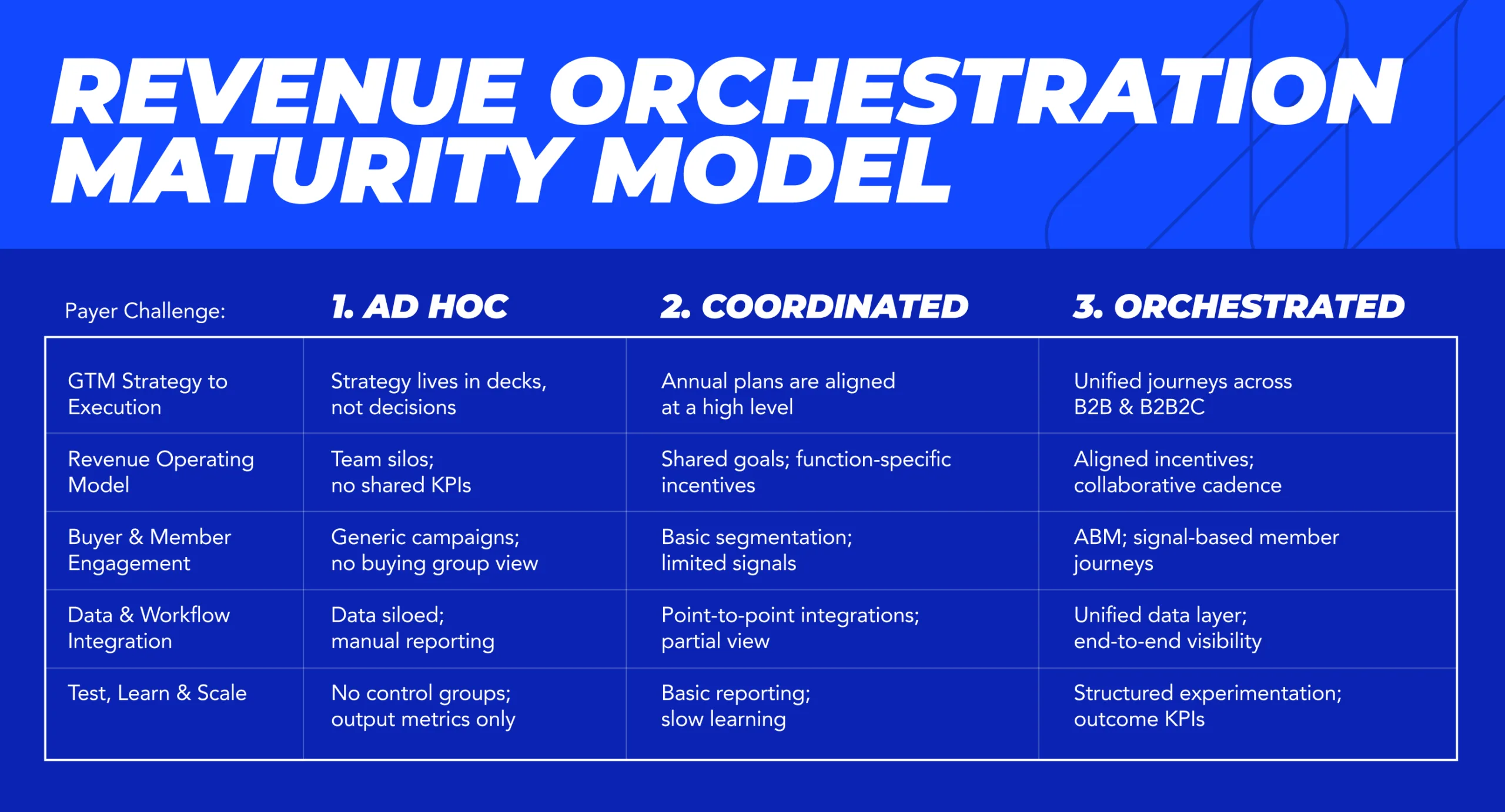
The goal is orchestrated, where signals connect, teams align, and engagement coordinates across the full lifecycle, from account to member to outcome.
That is where value is protected, and growth becomes durable rather than episodic.
The breakdowns described next are not isolated failures. Each maps directly to a dimension in this model, and each one explains why most organizations remain stuck between coordinated and orchestrated.
Where growth actually breaks
Six breakdowns, one operating model problem
1. Strategy and execution are disconnected
Strategy aligns in the boardroom but breaks down at execution.
Leadership priorities are clear: grow membership, improve experience, and advance value-based care. Execution fragments as these priorities move into sales, marketing, brokers, pharmacy, and clinical teams. Each function optimizes its own goals with no shared accountability for the full journey, from prospect to member to outcome.
The result is inconsistent messaging, broken handoffs, and early experience failures that undermine engagement, retention, and quality performance. The first ninety days are not onboarding. They are behavior formation.
2. Technology investment is outpacing capability
This is not a technology problem but an operating discipline problem.
Payers have invested heavily in marketing platforms, digital experience tools, and data infrastructure. But those tools are layered on top of legacy processes that were never designed to work as a system.
Without a clear operating model, modern platforms simply automate silos. The organization becomes more complex, more expensive, and no longer effective at driving sustained growth.
3. Business strategy is not driving digital experience
When experience is platform-led rather than business-led, engagement fails to drive behavioral change.
Digital experiences are often owned by IT or channel teams rather than by business leaders accountable for growth, retention, or quality outcomes. Journeys are built around systems instead of lifecycle needs.
The result is polished interfaces that look modern but do not guide members toward the behaviors that drive value. Digital becomes an interface rather than a growth driver.
4. Data exists but is not activated
Healthcare does not lack signals. It has an activation gap.
Organizations generate powerful signals across buyer intent, member engagement, clinical events, and pharmacy utilization. Yet those signals rarely trigger coordinated action across teams.
A diagnosis is recorded. Claims flow. Care teams are notified. But the member receives little timely guidance or support. The signal exists. The system does not act.
A practical perspective from our partner, Demandbase
The activation gap is rarely a data dap
Organizations often assume they have a data problem when they actually have an activation problem.
The activation gap becomes solvable when signals are defined clearly and connected to action. On the buyer side, this means identifying intent and engagement signals tied to specific growth motions. For healthcare organizations, those signals may include research activity related to self-funded employer plans, pharmacy benefit management, specialty drug programs, care management solutions, or competitor offerings. Combined with digital engagement, content consumption, solution inquiries, and broker interactions, these signals provide a clearer picture of account readiness and buying intent.
The same discipline applies after enrollment. Member portal activity, app registrations, benefit education engagement, care navigation behavior, EOB downloads, and provider-search activity all provide insight into member needs and engagement levels. When combined with clinical and pharmacy data, they create a member-side signal stream that can help organizations identify opportunities for intervention, support, and retention.
The activation gap is rarely a data gap. It is a gap in ownership, prioritization, and execution. If a signal does not have a defined owner, an assigned value, and a next-best action attached to it, the organization will not act on it, regardless of how clean or complete the data may be. The organizations creating sustainable growth are those that connect signals to coordinated action across every team responsible for the member and customer experience.
5. Measurement is fragmented and not aligned to value
Organizations measure activity, but they need to measure value.
Measurement remains channel-specific and function-specific, focused on volume rather than outcomes. Few organizations consistently track retention quality, lifetime value, margin impact, or behavior change.
As a result, teams optimize what is easiest to report, not what drives sustainable growth.
6. Critical capabilities lack ownership and execution
Capabilities without ownership do not scale, and growth remains reactive.
Payers know which capabilities matter. Retention modeling, predictive engagement, and signal-based prioritization are widely discussed. But too often, these efforts remain pilots with unclear ownership, limited funding, and no execution timeline.
Without discipline and accountability, orchestration stays theoretical, and growth never compounds.
The root cause
A broken signal system
These breakdowns are not independent failures. They are symptoms of a single underlying issue.
When signals are not orchestrated, growth becomes more expensive, unpredictable, and fragile.
Signals exist across buyers (intent, research behavior), members (engagement, digital activity), clinical systems (diagnoses, care events), and pharmacy (adherence patterns, utilization). But they are not connected across teams, prioritized by value, or activated in a coordinated way.
Without orchestration, journeys fragment, experiences degrade, and growth underperforms regardless of investment in technology, data, or campaigns.
The path forward
From fragmentation to orchestration
Leading organizations take a different approach. They are not adding more campaigns. They are redesigning how growth works, moving deliberately across each dimension of the maturity model.
They are:
- Aligning teams around shared outcomes, not functional metrics
- Connecting signals across the full lifecycle, from buyer intent to member behavior to clinical events
- Activating coordinated engagement across sales, marketing, brokers, pharmacy, and clinical teams
- Building measurement systems tied to lifetime value and behavior change, not activity volume
Most importantly, they are extending growth beyond the sale and into behavior and outcomes.
Summary
Revenue Orchestration for healthcare
This is what Revenue Orchestration looks like in a healthcare context.
A governed, measurable operating system that:
- Connects signals across the full lifecycle
- Aligns teams around shared outcomes
- Activates coordinated action, from account to member to outcome
- Measures what matters, including behavior change, retention quality, and lifetime value
In the maturity model, this is what makes orchestrated possible: real-time signal activation across buyer and member journeys, connected to a unified engagement operating model.
Signals alone are not the differentiator. The advantage comes from translating those signals into coordinated action across every team at every stage of the lifecycle.
What comes next
From understanding to operationalizing
Diagnosing the problem is necessary. It is not sufficient.
The organizations gaining ground are not those with the most sophisticated technology stacks. They are the ones that have connected their signals, aligned their teams, and built the discipline to act on both.
That gap between knowing and doing is where most payer organizations lose momentum. It is also where Revenue Orchestration creates a durable competitive advantage.
In part 2, we show how leading payer organizations build a unified signal system, connecting buyer intent, member engagement, clinical events, and pharmacy data into a coordinated operating model. More importantly, we show how those signals are translated into cross-functional actions that improve engagement, retention, adherence, and long-term growth.