
Most healthcare payers already have the signals they need to grow. The gap is not data. It is the operating infrastructure required to turn those signals into coordinated action across the lifecycle.
The employer RFP is not the beginning of the relationship. It is the end of a signal trail most payers never see.
By the time an employer issues a formal RFP, a decision is often already forming. Benefits leaders have been researching. Brokers have been engaged. Competitors have been building relationships quietly through content, events, and digital touchpoints. The payer that wins is often not the one with the best proposal, but the one that engages when intent first surfaces.
But that is only half of the problem.
Even payers that invest in identifying in-market employers and activating buying groups often lose the value they worked to win because their signal system stops at the contract.
What happens after enrollment, whether members engage, adhere, and navigate care effectively, is driven by a different set of signals. Clinical events. Pharmacy patterns. Digital behavior. Satisfaction data. In most payer organizations, these signals are managed in isolation, disconnected from the operating model that won the account.
The organizations pulling ahead are not generating more signals. They are building the infrastructure to act on the signals they already have across the full lifecycle, from employer intent to member outcome.
The signal problem
Signals exist. The system does not.
Signal intelligence capabilities can play an important role in helping payer organizations identify early buying activity, stakeholder engagement, and emerging lifecycle risk. They surface early buyer intent signals, identify active buying groups, and enable more precise account prioritization across complex healthcare markets.
Signal visibility alone is not enough. The differentiator is how those signals are connected to coordinated action across the full lifecycle, from pre-sale engagement to post-sale member outcomes.
In part 1, we identified the root cause of stalled growth in payer organizations: Signals are not orchestrated into action. That problem has two dimensions that are rarely addressed together.
Dimension 1: Pre-sale signals are underused
Most healthcare payer marketing and sales teams still operate from a narrow set of signals. Broker relationships. RFP timing. Limited intent indicators. Few have built the infrastructure to systematically identify which buyers are in-market, which stakeholders are engaged, and how to activate coordinated outreach before the buying process formalizes.
The result is a reactive sales motion that looks proactive on the surface. Teams respond to RFPs they could have shaped. They compete for accounts they could have preempted. They engage buyers similarly when signals indicate different levels of readiness.
Employer benefit decisions typically involve six to eight stakeholders across HR, Finance, and Benefits. Intent surfaces across multiple contacts weeks or months before a formal process begins.
Key insight:
Most payers wait for the RFP. Leading payers read the signals.
Dimension 2: Post-sale signals are disconnected
After enrollment, payer organizations generate enormous volumes of signals but rarely connect them to coordinated action.
- A member registers for the portal but never completes onboarding
- A newly diagnosed diabetic fills a first prescription but misses the second
- A high-cost member engages once with care management and then disengages
- Claims and satisfaction trends begin drifting toward patterns that predict past defections
Each of these is a signal. Each represents a moment where coordinated intervention could have changed the outcome.
But in most organizations, these signals live in separate systems, owned by separate teams, with no shared activation model.
The signal lifecycle
One continuous stream, not separate systems
The most important reframe for payer growth leaders is this: Pre-sale and post-sale signals are not two different problems. They are two ends of the same lifecycle, and they must be managed by the same operating infrastructure.
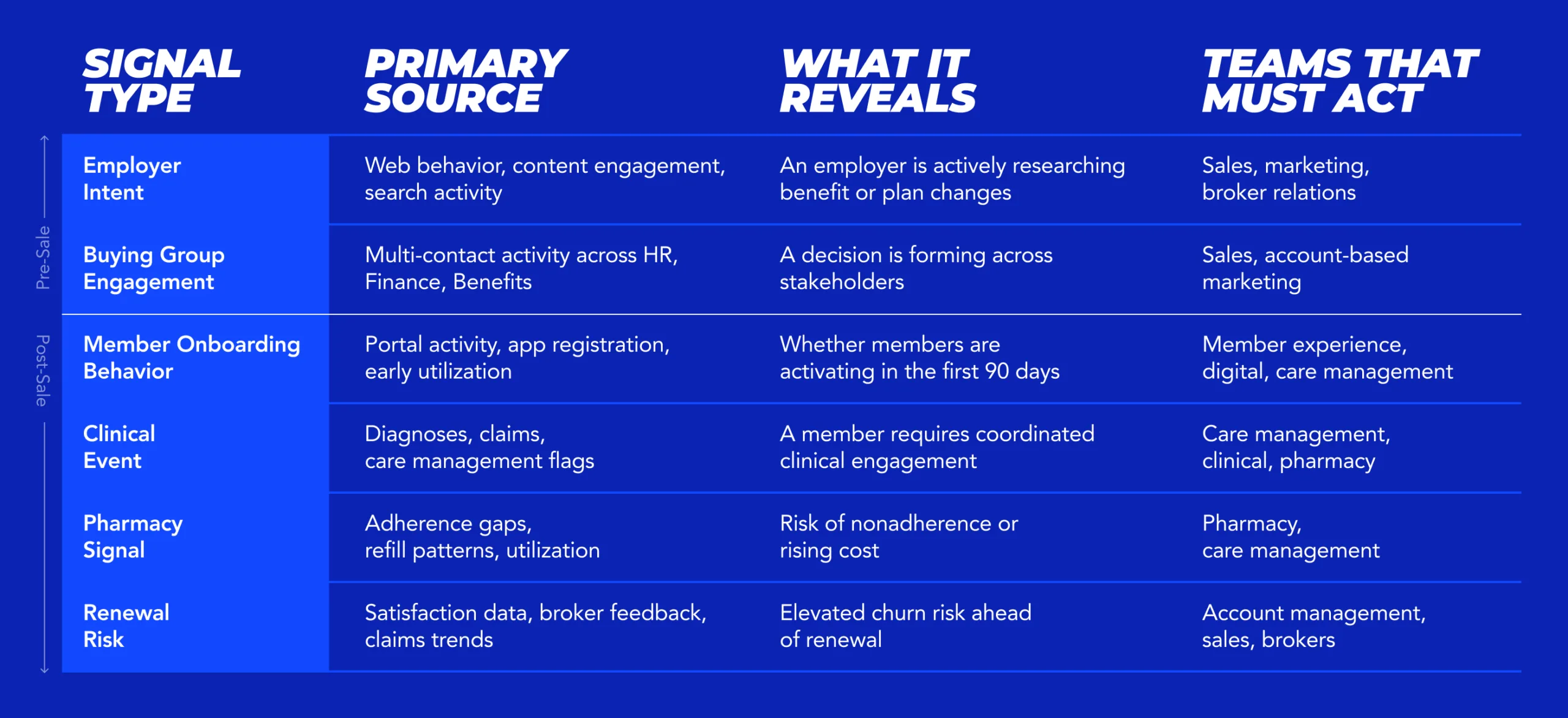
Two things stand out
First, the signal lifecycle does not end at the contract. It compounds. Retention is a lagging indicator of member engagement, adherence, and experience.
Second, these signals only create value when they are connected, prioritized against value, and activated through a shared operating model.
Pre-sale intent signals and post-sale member signals are not separate systems. They are one growth equation, connected by a Revenue Orchestration operating model that most payer organizations have not yet built.
Building the signal system
Three principles that separate orchestrated from coordinated
In part 1 of this article series, we introduced the Revenue Orchestration maturity model, which maps the progression from ad hoc to coordinated to orchestrated execution. The gap between coordinated and orchestrated organizations is not technology. It is operating discipline.
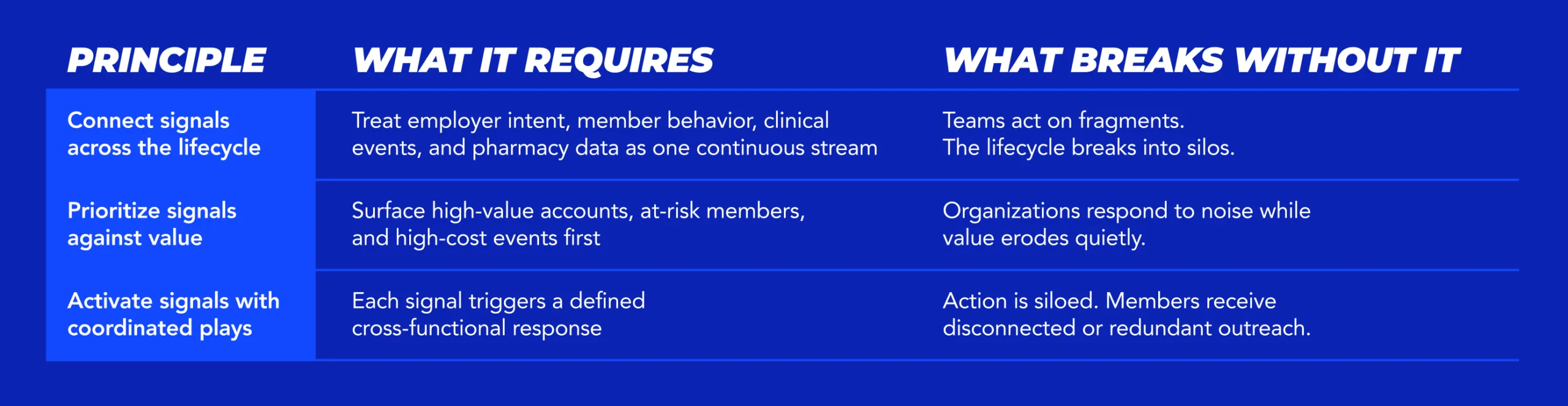
These principles require deliberate operating model design, not additional platforms or campaigns.
Organizations that operationalize signal orchestration typically build three foundational capabilities: a unified signal inventory, a shared prioritization model, and a coordinated play framework that connects signals to cross-functional action.
Signal, score, and play. This is what separates organizations that have dashboards from organizations that have a true operating system for growth.
A practical perspective from our partner, Demandbase
From signals to operational discipline
Operationalizing lifecycle orchestration comes down to three foundational capabilities: defining signals, scoring them consistently, and connecting them to coordinated action.
- Build a unified signal inventory
Organizations need a centralized inventory of signals across the full lifecycle, including:
- Intent keyword sets
- Web behaviors
- Campaign engagement
- Clinical events
- Pharmacy patterns
- Onboarding activity
- Renewal indicators
Signals should be organized by GTM motion—employer, broker, Medicare Advantage, Medicaid, specialty pharmacy—with overlap removed so activity is not double-counted across teams or systems.
- Create a shared scoring model
Not all signals should carry equal weight.
Signals should be scored based on:
- Specificity
- Timing
- Stakeholder influence
- Competitive relevance
- Lifecycle stage
Higher-value signals may include:
- Competitor keyword research
- Trending spikes against an account’s historical baseline
- Pricing-page visits
- RFP-readiness engagement
- Coordinated buying-group activity across multiple stakeholders
Stakeholder role context also matters. Activity from HR Benefits Directors, CFOs, or clinical leaders should carry greater weight than low-influence visitors.
Generalized category research should maintain relatively low engagement value to prevent inflated scoring and false buying signals.
The goal is not to maximize activity. The goal is to identify concentrated buying or engagement behavior at the right moment.
- Operationalize signals through olays
Every meaningful signal threshold should trigger a defined response:
- Who is notified
- What outreach is activated
- The next-best action
- How outcomes are measured
Signal. Score. Play.
That operational discipline is what separates organizations with dashboards from organizations with orchestrated systems.
Mapping signals across the lifecycle
A practical framework for payer organizations is aligning signals to four lifecycle stages:
| Stage | Representative signals |
|---|---|
| Awareness | Third-party intent, ungated content engagement, early broker or HR research activity |
| Acquisition | Multiple stakeholder engagement, gated content consumption, repeat visits to solution pages |
| Acceleration | RFP-readiness activity, pricing-page engagement, high-intent buying-group behavior |
| Member/ Customer | Onboarding completion, portal activity, adherence patterns, satisfaction trends |
As accounts move through the lifecycle, engagement strategy, content, and outreach should escalate accordingly.
Most importantly, the same underlying data layer should persist across every stage of the journey rather than splitting engagement into disconnected marketing, sales, and member experience systems.
In practice
What a connected signal system looks like
Scenario 1: The employer you almost missed
An employer begins showing elevated intent across multiple stakeholders months before an RFP. In an orchestrated model, the account is surfaced early; outreach is coordinated across sales, brokers, and marketing; and relationships are built before price becomes the primary lever.
The result is earlier influence, stronger positioning, and reduced-price sensitivity before formal procurement begins.
Scenario 2: The member you almost lost
A newly enrolled member with a chronic condition disengages after the first prescription fill. The absence of activity triggers a coordinated intervention across pharmacy, care management, and member experience before adherence gaps become outcome gaps.
The result is improved adherence, lower avoidable utilization, and stronger member retention.
Scenario 3: The renewal you saw coming
Claims trends and satisfaction data surface early risk, well ahead of renewal. A cross-functional retention play activates to address root causes, not just manage the relationship.
The result is proactive retention management rather than reactive renewal defense.
In each case, success is measured against outcomes such as retention, adherence, and cost of care, not activity metrics.
The operating model requirement
Technology does not build this. The operating model does.
Every scenario above depends on the same fundamentals: clear signal ownership, defined activation plays, shared accountability, and outcome-based measurement.
Coordinated organizations often have the tools. Orchestrated organizations have the discipline to use them together.
Revenue Orchestration is not a platform you buy. It is an operating system you build around the signals that matter, the plays that activate them, and the outcomes that prove value.
Where to start
The diagnostic that changes the conversation
The most productive starting point is not a technology initiative. It is a diagnostic question.
Key diagnostic question:
Where in our lifecycle are signals going dark, and what is that costing us?
That question aligns teams quickly because the answer is visible and measurable. From there, organizations can pilot targeted signal plays, prove impact, and scale with confidence.
A useful starting point is determining whether existing signals are truly operationalized. Many organizations collect engagement, intent, clinical, and utilization signals, but they lack defined ownership, prioritization, activation plays, or measurable outcomes tied to them.
If a signal does not have a defined owner, a prioritized engagement value, and a measurable outcome attached to it, the signal is decorative rather than operational.
Leading organizations start by building a complete signal-to-play-to-outcome loop around one high-value growth or retention motion before scaling orchestration more broadly across the lifecycle.
The competitive advantage
The payers that win in the next five years
The healthcare payer market is not short on investment. It is short on connection.
Organizations are investing heavily in data infrastructure, digital experience, care management, pharmacy optimization, and go-to-market capability. Most of those investments generate signals. Few are connected to a system that translates those signals into coordinated action across the full lifecycle.
The payers that build a true signal system, connecting intent to member behavior, member behavior to outcomes, and outcomes back to retention, will not just grow faster. They will grow more predictably and more profitably.
They will connect external intent signals with internal engagement, clinical, and pharmacy data, turning fragmented insight into coordinated action at scale. They will intervene earlier, retain longer, and compound value over time rather than resetting relationships at each renewal cycle.
That is the advantage Revenue Orchestration creates: not better campaigns or more data but a growth operating system built to see the signal and act on it.
The signal is already there. The advantage belongs to organizations built to act on it.
Virtual workshop: Building signal-driven healthcare payer growth models
Join Marketbridge and Demandbase for a virtual workshop exploring how leading payer organizations operationalize signal orchestration across the full lifecycle — from employer intent and buying-group engagement to member behavior, adherence, and retention.
Topics include:
- Building a unified signal inventory
- Prioritizing high-value buyer and member signals
- Designing signal-to-play orchestration models
- Aligning sales, marketing, pharmacy, and care management workflows
- Measuring retention, engagement, adherence and lifecycle outcomes