
The buying journey for health insurance has changed
In health insurance, just being known isn’t enough to win. Most buyers already recognize the major carriers from their jobs, their doctors, or long-term experience. The real decision happens when buyers start comparing plans, weighing coverage, costs, provider networks and tradeoffs. For years, this comparison took place in obvious spots like broker meetings, benefits portals, or comparison pages. You could tell someone was considering your plan because they interacted with your materials.
But now, the consideration stage of the buying journey has shifted dramatically. More often, buyers make their shortlist and learn about options through AI-generated answers before they even visit your website, speak to a broker, or you realize they’re considering your plan. According to Forrester’s 2026 Buyers’ Journey Survey, AI answer engines have become the top research tool for buyers, ahead of company websites, salespeople, and product experts. Bain also found that 80% of consumers use “zero-click” results—answers they get without visiting a website—in at least 40% of their searches.
So now, health insurance marketers need to ask the question: when an AI assistant explains health insurance to a buyer, whose explanation does it trust?
In practice, one of the clearest signals of AI trust is citation. When an AI-assistant like ChatGPT, Gemini, Claude or Copilot includes your content in its answer, it’s indicating that your information was credible enough to use. When it picks a coverage explainer instead of a brand page, it’s deciding which source is more reliable. AI tends to favor information that is credible, consistent and easy to retrieve and verify.
There is no universal GEO playbook
It’s natural to reach for the standard GEO (Generative Engine Optimization) checklist: structured content, FAQs, schema markup, and authority signals. These foundations are still important. But they assume generative AI engines build trust the same way across every industry—and they don’t.
A Marketbridge study of more than 17,000 AI citations across industries like cybersecurity, cloud, finance, manufacturing, software, and healthcare found that AI judges credibility differently in each category. There’s no one-size-fits-all GEO playbook. The real question is, “What does AI reward in health insurance?”
The answer: reduce buyer uncertainty
Across industries, AI appears to reward the sources that best help users solve the dominant information problem in that category. In cybersecurity, it’s technical authority. In manufacturing, operational expertise. In health insurance, reducing buyer uncertainty. Buyers are trying to understand complex choices with significant financial consequences.
AI tends to favor the sources that help buyers make sense of those choices. It’s not looking for the loudest brand; it’s looking for the clearest explanation. Organizations that clearly explain coverage, eligibility, enrollment, and plan differences are more likely to earn citations than those focused primarily on promotion.
That’s because health insurance is inherently complex and often viewed with skepticism. The organization that best helps buyers make sense of their options is often the one AI chooses to cite.
Like you, AI treats B2B vs. B2C differently
Health plan teams usually own either the B2B or the B2C side, not both. AI also treats them as two separate audiences.
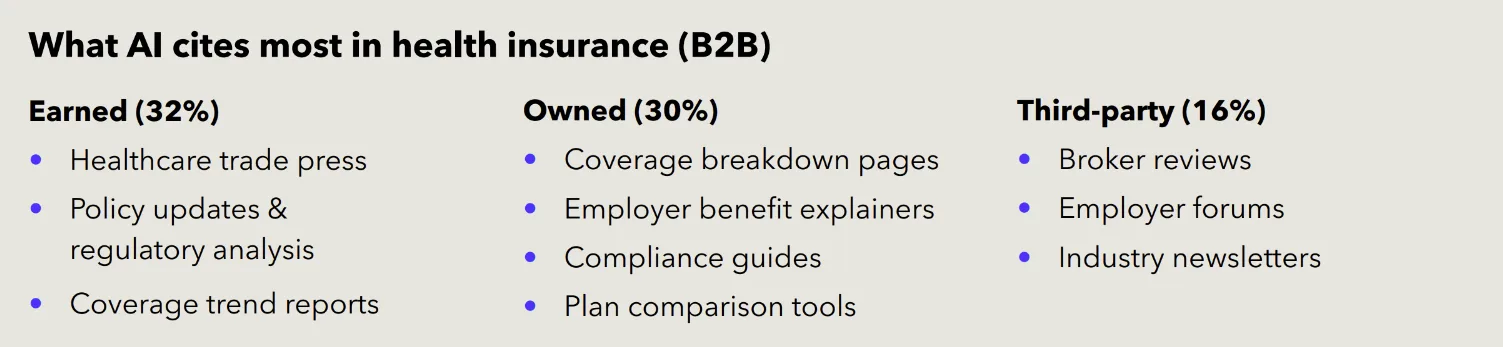
A B2B buyer, such as an HR leader, broker, or employer, is focused on reducing organizational uncertainty—including compliance risk, costs, and plan design. In these cases, AI prefers authoritative sources: earned media makes up 32% of citations, with owned content close behind at 30%. The sources AI cites most are healthcare trade press, regulatory analysis, compliance guides, and employer benefit explainers.
Employers need confidence that they’re making the right organizational decision, so AI leans more heavily on validation from earned media.
Source: Marketbridge, The Go-To Guide to Verticalized GEO, 2026
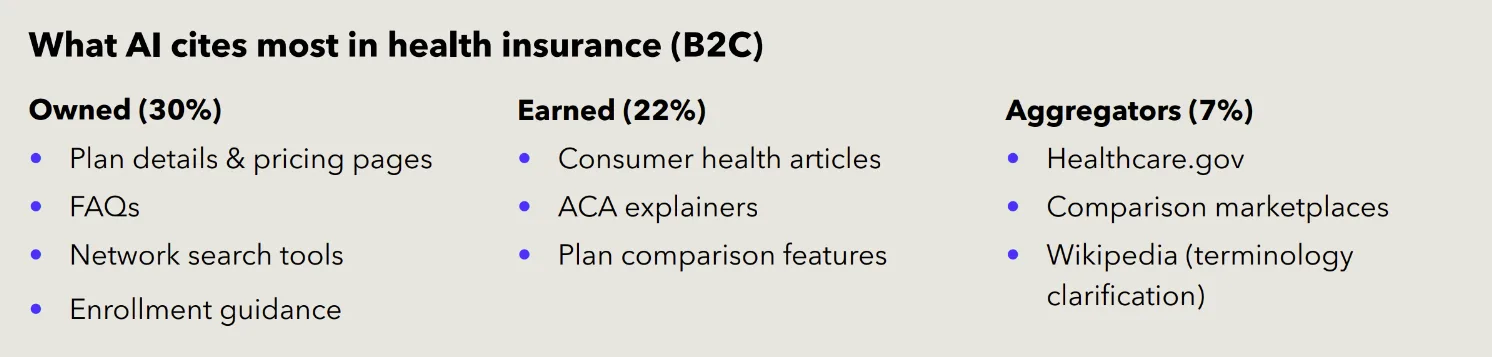
A B2C buyer, or a consumer picking a plan, is focused on reducing personal uncertainty—like which plan to choose, which network to use, how much it will cost, and how to enroll. Here, utility matters most: owned content leads at 30%, ahead of earned media at 22%. The most important sources are practical ones, such as plan details, pricing pages, FAQs, network search tools, enrollment guides, plan comparison.
Consumers need practical answers about their own coverage, so AI more often turns directly to insurers’ explanatory content.
Source: Marketbridge, The Go-To Guide to Verticalized GEO, 2026
The same trust principle—reducing uncertainty—shows up in two ways. Different audiences have different information needs and ways of being seen. That means each needs its own GEO strategy.
The context of owned content is everything
In both B2B and B2C health insurance, owned websites make up 30% of citations. That’s one of the highest rates among all sectors studied and higher than the 27% cross-industry average.
It’s easy to think, “AI prefers owned content in health insurance.” But the numbers alone don’t tell the whole story. What matters is which owned pages get cited. For health insurance, the owned URLs AI uses are almost always explanatory—such as coverage breakdowns, eligibility rules, network directories, FAQs, and enrollment or compliance guides—not brand or campaign pages. That’s the real insight. If the 30% came just from publishing a lot or having a strong domain, we’d see more promotional pages cited, but we don’t. AI chooses explanation over persuasion, even within the same website.
Health insurers occupy a unique position in the AI ecosystem. When it comes to questions about their own coverage, a health plan is the top authority. The facts themselves aren’t secret—every plan is filed with CMS and published, and aggregators use that public data. Still, the insurer is the primary source for direct coverage information. But just having the facts isn’t enough. You need to make your explanation clear and easy to find on a page that AI can reference. If you don’t, someone else will paraphrase your information, and AI will cite their version instead of yours.
Your expertise doesn’t matter if AI can’t find it
The carrier may have genuinely earned the right to explain ICHRA. Its experts speak at conferences, educate brokers, and answer these questions every day. The problem is that much of that expertise lives in places AI can’t cite, such as keynotes, booth conversations, sales presentations, and customer meetings.
When the employer asks an assistant, “How does ICHRA work,” a benefits-platform with a clear explainer page earns the citation. When the employee later asks, “Which plan should I pick with my allowance,” the carrier’s own plan pages may be missing or difficult for AI to use, so an aggregator answers that question instead. The carrier isn’t losing on authority. It’s losing on visibility.
As a result, the insurer loses visibility twice: first when employers learn about ICHRA, and again when employees compare plans. Much of a health plan’s expertise still lives in pre-AI channels, while today’s buying decisions increasingly begin with AI. The challenge isn’t proving you have authority; you already do. It’s turning that authority into content AI can find, understand, and cite.
This is bigger than content
If AI picks the clearest explanation no matter who wrote it, then trust isn’t owned by just one team in a health insurance organization anymore. AI doesn’t care about organizational silos or media channel boundaries. It pulls together signals from earned media, owned content, analyst research, regulatory sources, and community platforms to create a single answer.
This changes the usual way of working. In most health plans, the key explanations are spread out—compliance handles regulatory language, product manages plan design, member education writes FAQs, and communications deals with the press. When these teams work separately, buyers – and the AI engines serving them – encounter inconsistent explanations across sources. That inconsistency makes it harder to establish authority. The organizations that succeed aren’t the ones publishing the most, but the ones who bring PR, content, SEO, compliance, product, and member education together into a single, clear message. GEO is a cross-functional effort, not just a content tactic.
The goal isn’t just to be seen. It’s to have influence.
It’s easy to think this is just about getting cited more often, but it’s not. Health insurance organizations have spent years earning credibility with employers, brokers and consumers. Now, AI is shaping which organizations buyers encounter and which information they rely on before they ever interact with a brand.
You won’t win with bigger campaigns or stronger brand messaging alone. You’ll win by becoming the organization AI turns to for clear, consistent explanations of health insurance, wherever it looks for answers.
Health insurance has struggled with trust for years. AI isn’t changing that. It’s becoming the first place buyers decide which information, and ultimately which organizations, deserve their confidence.
To see the full picture, check out Marketbridge’s cross-industry study of 17,525 AI citations. You can read The Go-To Guide to Verticalized GEO—no gate, no form—for a complete breakdown by sector. Or contact us to schedule a key findings walk-through for health insurance leaders.