
Despite claims to the contrary, the role of marketing won’t be replaced by AI. Enterprises won’t be run by a single marketer overseeing a complex web of AI agents and tools.
But we’re all feeling the shifts happening. AI is fundamentally changing the way prospects learn about and shop for goods and services, particularly in B2B transactions. Many enterprises are struggling to adapt. The ones that are succeeding have created a unified Go-to-Market system, and aligned systems-oriented practitioners who can orchestrate execution across marketing, sales and CX with a cross-functional focus on ROI rather than departmental credit.
Traditional marketers adapted to technology
In the past, technology drove marketing to evolve, and marketers adapted to those changes. Marketing automation tools gave marketers more control over the buyer journey, which meant we could blast a huge segment at a moment’s notice. Search engines drove us to learn to keyword-stuff blog posts, put high-value content behind forms, and inundate form fillers as hand-raising hot leads.
Expansion of available marketing channels meant building additional expertise within marketing teams. As teams grew, work became more siloed with dedicated experts. Though campaigns were often planned cross-functionally, execution struggled to follow. Campaign optimizations often were handled within channels, further straying from the collaboratively built plan.
And metrics evolved as technology changed. Total rating points (TRPs) from TV and pieces mailed evolved to impressions, clicks, video views and form fills. Highly trackable actions were easier to justify to leadership and typically enjoyed higher budgets. But as each marketing channel optimized to its own KPIs with in-platform metrics, conversions were often double-counted and difficult to de-dupe on the back end, creating ambiguity in results.
The traditional way is no longer working
But now AI is further obscuring signals. No one fills out a form anymore. The buyer journey is largely unknown. Forrester’s Buyers’ Journey Survey reported that 92% of B2B buyers had a shortlist in 2024. And a 2024 TrustRadius and Pavilion survey found that 71% of buyers purchase their top choice from the shortlist. If you multiply these two numbers, about 65% of B2B buying decisions are “foregone conclusions,” as my colleague Andy Hasselwander said on his recent B2B measurement webinar.
The old playbook isn’t working. Enterprises that are succeeding are working differently.
Systems marketers collaborate with technology
Today marketers need to collaborate with technology, specifically AI, rather than adapting to it. Systems marketers are fluent across the Go-to-Market system, understand how data flows and can align strategy across those functions and constraints. They leverage AI to execute their strategy and build efficiencies by identifying the right use cases for their enterprise.
Systems marketers also know that traditional metrics are insufficient in today’s low-signal environment and are defining new ways to measure effectiveness. While some utility will still exist for in-platform and early-signal metrics, prioritization across marketing and sales require different KPIs—and arguably a more significant focus on ROI and effectiveness. B2B marketers need deep understanding of the levers for driving revenue, the objective for each, and the intermediate metrics that can be monitored. (See illustration below)
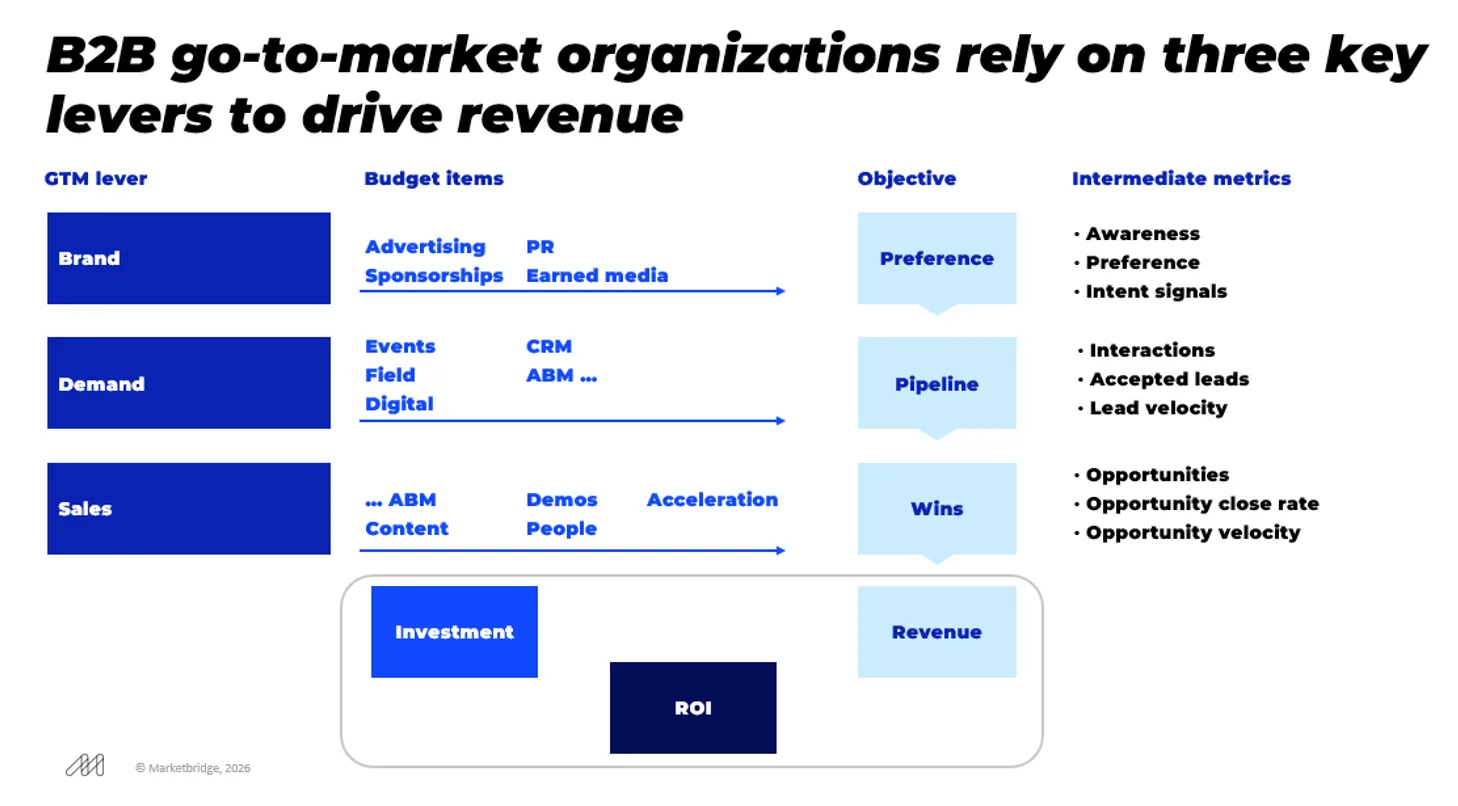
But because so much of the buying cycle is unobserved (and the shortlist predetermined), it’s essential to have an impactful brand and a cohesive orchestrated message across all channels as well as the entire buying group. Systems marketers know how to unify marketing and sales execution with customer experience to drive real revenue outcomes.
How to shift to systems marketing
Systems marketers know their organization’s revenue motions and current sales dynamics, and build marketing campaigns that complement those efforts to drive measurable business outcomes. They understand what data is available, where it exists and the tech stack that connects it. Organizations that have created a unified Go-to-Market system are aligned to driving revenue and growth, not department KPIs.
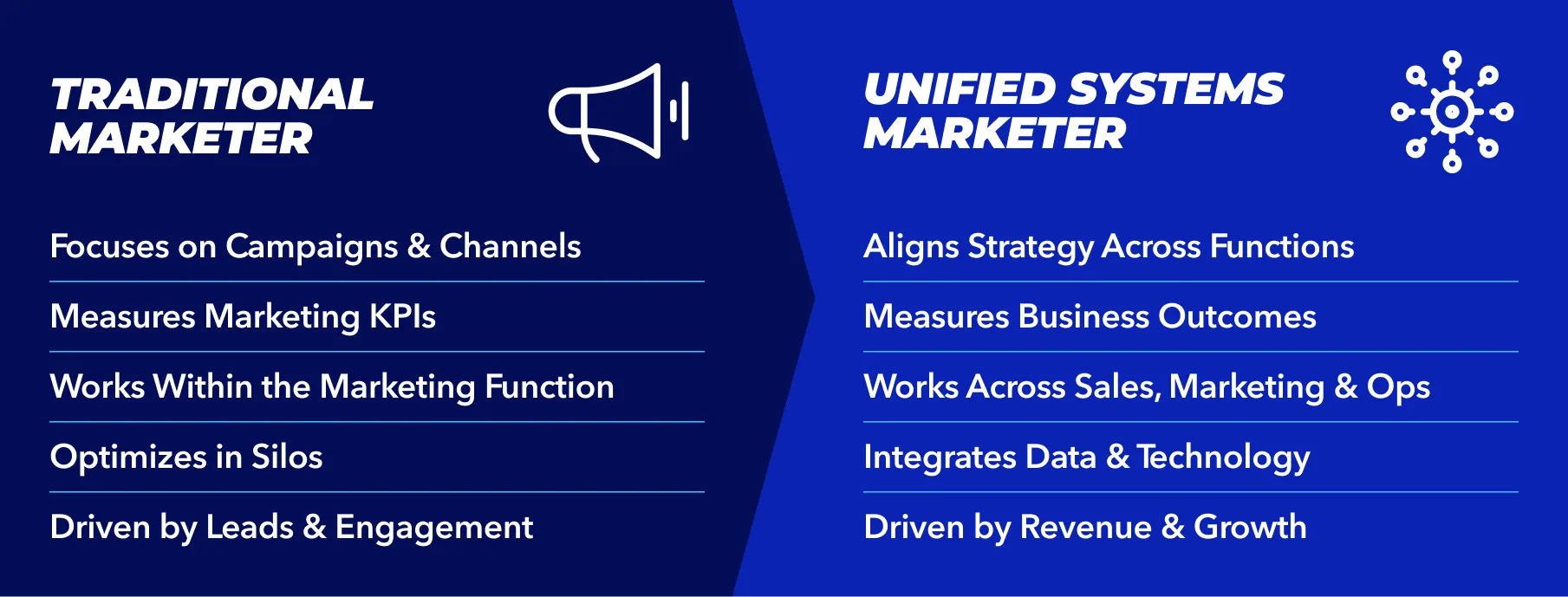
Enterprises organized around traditional marketing teams need to evolve their operating model and process, and upskill teams on new ways of working and measurement methodologies.
These enterprises should:
- Reexamine how campaigns are conceived and the strategies built.
- Look at touchpoints across the GTM engine.
- Evaluate:
- What are the topics discussed (or not discussed)?
- What’s the frequency?
- Who brings results to the table? (Hint: Comparing data across functions ensures alignment on KPIs and agreement on data sources.)
- Audit what signals the enterprise is using, how those metrics have changed over time, and whether the KPIs are predictive of outcomes today.
Other key questions for consideration during a systems marketer transformation:
- Is the right data available to prioritize sales and marketing efforts?
- Are all teams across GTM aligned on the strategy, execution and rules of engagement?
- What metrics should be used for monitoring, reporting and decisioning?
If you’re not sure where to start, reach out to discuss our GTM assessment.
Conclusion
While marketing has always strived to orchestrate a cohesive account experience, the rise of AI, the fall in observable behaviors and the change in how buying groups make decisions require a truly unified approach. The enterprises succeeding now know that growth depends on cross-functional coordination and that all GTM functions need to deeply understand revenue operations and data. Systems marketers are developing a durable and critical capability: the ability to collaborate with and orchestrate technology as it continues to evolve.