Sharpening the edge: How focused AI integration is transforming B2B sales organizations

There’s no shortage of buzz around AI, but what separates the leaders from the pack is not experimentation for experimentation’s sake. Rather, organizations that are successful in unlocking AI’s value for B2B sales are hyper-focused on where intelligence can move the needle and deliver results.

At the center of the issue is a recognition that, in theory, AI has potential to reshape every aspect of the go-to-market (GTM) organization ― from prospecting and pipeline management to customer support and pricing. In practice, however, leaders confront pressing realities: budgets for technology and transformation are finite, and teams already face limits on how much change they can absorb.

Instead of spreading resources thinly across the latest AI trends, success demands a disciplined focus on the highest impact opportunities, and constant attention to downstream organizational implications to turn AI investments into measurable results.

From possibility to impact: The critical importance of focus

For sales leaders, translating AI’s wide-ranging potential into practical tangible outcomes starts with identifying the right problem to solve. The key is not in asking, “where could we apply AI?” but rather, “where should we apply it first?”

The answer lies in framing AI opportunities through a clear set of guiding questions that connect business priorities, process pain points, and organizational readiness such as:

  1. What are the strategic GTM priorities over the next year (new logo, cross-sell, churn reduction, etc.)?
  2. Where in the sales process do reps or managers lose the most time?
  3. Which parts of our sales model create the most drag on performance today?
  4. Where would enhanced insight or foresight most change seller and buyer behavior?
  5. Do we have the data and organizational readiness to act here?

High-performing teams use these questions to cut through the noise and target a handful of use cases where AI can truly change the game. Instead of scattering bets across pilots, they invest in focused applications that drive measurable business value.

Consider five proven examples:

  • Dynamic lead scoring: Equipping teams to identify and act on accounts most likely to convert, streamlining prospecting for greater efficiency and increasing qualified pipeline coverage.
  • On-demand sales intelligence: Providing real-time access to relevant product, technical, industry, and client information, enabling sellers to navigate even the most complex conversations without pulling in additional specialist resources.
  • AI-enabled sales coaching: Leveraging analytics platforms and conversational intelligence to provide real-time, personalized coaching to reps—guiding call strategies, recommending best practices, and helping sales managers tailor development to each team member’s strengths and opportunities.
  • AI agents for inside sales: Deploying conversational AI avatars to qualify leads, book appointments, and handle routine inquiries before seamlessly passing high-potential prospects to human reps.
  • Pricing optimization: Adapting pricing in real time based on client behavior and market conditions, helping teams close deals faster and at better margins.

New capabilities, new operating models

Done correctly, successful AI deployment should not simply tweak workflows; rather, it should help to inform the future shape of the sales organization itself. As automation handles more data analysis and tactical decisions, the burden of manual, repetitive tasks shrink. Account executives shift toward relationship-building and strategic thinking. Operations and enablement teams shift from report builders and content archivers to stewards of data quality and insight. In aggregate, these shifts enable GTM organizations to deploy fully empowered teams designed for agility and impact.

For example:

  • AI-enabled account executives: At a global SaaS company, account executives use AI assistants embedded in their CRM. Rather than depending on a separate team of product specialists, they instantly access up-to-date case studies, technical specs, and dynamic pricing proposals ― strengthening credibility and accelerating sales cycles.
  • Operations as a strategic center of excellence: An industrial manufacturer consolidates its sales operations and analytics into a single “insights” team. This group goes well beyond reporting; they continually curate and upgrade the data that AI models rely on, so field reps always act on the clearest possible view of client needs.
  • AI agents for inside sales: A technology firm deploys conversational AI avatars to manage the initial stages of prospecting ― qualifying leads, booking appointments, and handling routine inquiries before seamlessly passing high-potential prospects to a human touch. This reallocation of effort allows business development reps to focus on high-value client engagement and strategic nurturing, while machines efficiently scale outreach and qualification.

These shifts let people do what machines can’t: listen, collaborate, and build trust ― faster and with more precision than ever before.

Common pitfalls

Even well-intentioned AI programs stumble when the basics aren’t in place. Two pitfalls in particular tend to limit momentum before value is ever realized.

  1. Underestimating the data lift
    AI doesn’t run on hope ― it runs on clean, connected data. Too many sales teams launch pilots only to discover their CRM is riddled with duplicates, gaps, and outdated records. Without sustained investment in data quality, governance, and integration, even the most advanced AI deployments stall.

    Key imperatives:
    • Treat data stewardship as a core enablement function, not an afterthought.
    • Establish clear ownership for data quality across sales, marketing, and operations.
    • Start with one or two critical data domains (e.g., accounts, opportunities) before scaling.
  2. Treating technology as the strategy
    AI can sharpen decisions and automate repetitive tasks, but it cannot replace judgment, creativity, or trust-building. Leaders who treat AI as a silver bullet risk weakening customer relationships and demotivating teams. Technology should enable—not dictate—the sales strategy.

    Key imperatives:
    • Position AI as a strategic enabler providing guidance and augmentation, not replacement.
    • Reinforce the uniquely human strengths GTM teams bring: teamwork, empathy, negotiation, creativity.
    • Set adoption expectations early and broadcast success stories throughout the change management cycle.

Principles for sales organizations in 2025

  • Prioritize ruthlessly: Anchor every initiative in business value, rather than novelty or hype.
  • Redesign deliberately: Let structure follow strategy, adapting roles to maximize new capabilities.
  • Invest in data: Treat data quality and integration as non-negotiables.
  • Retain a human core: Encourage teams to use AI as a catalyst for insight and creativity, not a substitute for them.

The future of B2B sales will be shaped by leaders prepared to invest with discipline, reimagine their structures, and blend technological horsepower with human-led strategy and ingenuity.

If you want help evaluating if your organization is ready for AI or which use cases to implement first, get in touch.

GEO webinar: AI’s new frontier of brand visibility

GEO webinar: AI’s new frontier of brand visibility

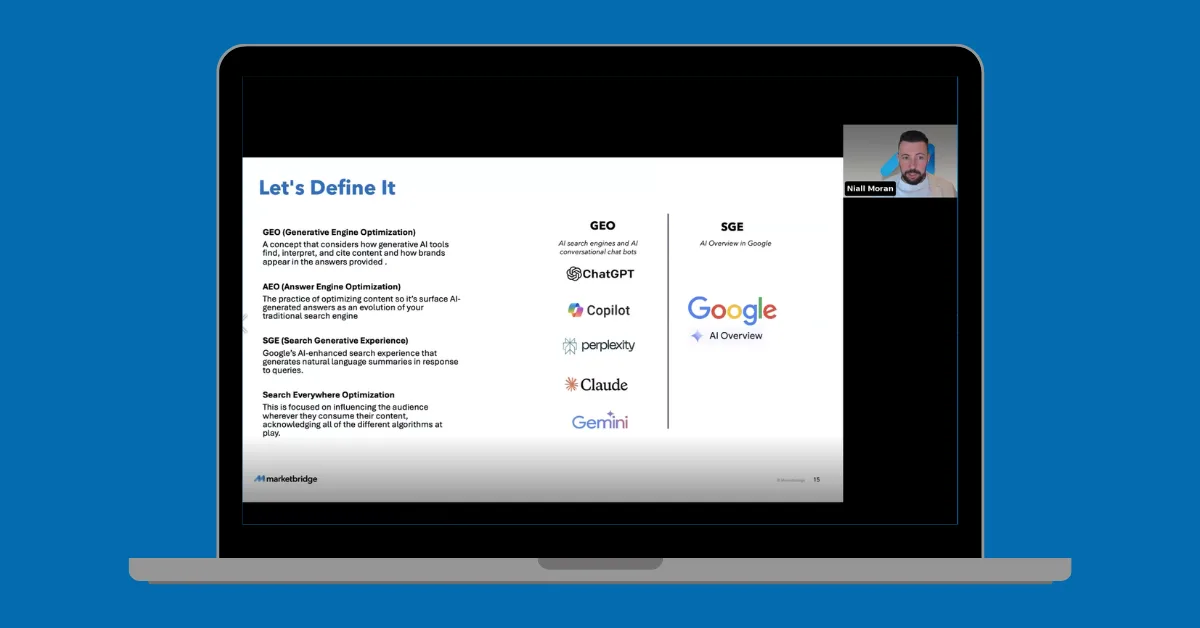
A webinar on how to harness the power of GEO

With AI-powered tools like Chat GPT, Perplexity and Gemini transforming how people search for and consume information, the SEO playbook is racing to keep pace. There’s a lot of information swirling around, but amidst the hype sits an important truth: if your marketing and communications plans for the next quarter aren’t addressing how your brand shows up in generative engines, you’re already falling behind. As organizations look to swiftly mobilize on the topic, there’s no shortage of content offering top ten tips and failsafe strategies. From shifting focus to long form content, doubling down on influencer activity to building your profile on Reddit. But for those without endless resources or the ability to effortlessly pivot their entire marketing strategy, how do you identify which of the possible plays will make the most difference to your business?

Access the recording of our recent webinar, hosted live on September 2, 2025, to uncover:

  • The evolving GEO landscape
  • Navigating the myriad tools available
  • Actionable strategies and quick wins to enable PR, content and digital teams to impact GEO outcomes
  • Ways we can start to set KPIs and meaningfully measure effectiveness in this dynamic field.

Thank you for Downloading

Lorem ipsum dolor sit amet, consectetur adipiscing elit. Phasellus vel tincidunt turpis. Fusce tristique cursus malesuada. Pellentesque euismod nisi eget nunc sagittis ullamcorper. Duis vitae aliquet diam. Proin a blandit nisl. 

Subscribe to Marketbridge Updates

What’s next?

Why your GTM Strategy needs a unified data backbone (and it’s not just a CDP)

You’ve heard it…the promise of a “360-degree view” of customers and prospects. It’s a north star that’s both commonly referenced and frustratingly out of reach for many marketing leaders. It’s even landed in the “trough of disillusionment” on Gartner’s Hype Cycle, the place where overhyped tech goes after reality sets in.

While a Customer Data Platform (CDP) certainly has benefits, like enabling personalized campaigns and orchestrating cross-channel journeys, it is often limited by its out-of-the-box focus on marketing activation, rather than comprehensive strategic insight.

Where we often see CDPs fall short:

  • They’re primarily built for activation, not strategic planning.
    CDPs excel at delivering personalization at scale (like deciding which creative to show based on customer attributes). But they’re often not architected to support the kind of complex questions CMOs face, for instance measuring true marketing contribution to revenue, or forecasting ROI by channel and segment.
  • They depend on other systems to prepare and pipe in broader GTM data.
    While CDPs can receive sales, finance, and LTV data, that information typically needs to be modeled elsewhere, limiting the CDP’s role in end-to-end GTM analysis and decision-making.
  • They can lock teams into a single vendor ecosystem.
    Many CDPs are sold by marketing cloud platforms whose primary goal is stickiness. This means future needs could be constrained by their plans vs. yours.

In short, while a CDP can improve campaign execution, it rarely gives CMOs the full GTM picture needed to steer investment decisions, defend budgets, or adjust strategy mid-quarter.

What A Unified GTM Data Backbone Looks Like

A true go-to-market data backbone, what we’ve named a Go-to-Market Data Lake (GTMDL), can change the game. A GTMDL is an independent, GTM-specific database that serves as the single source of truth for your go-to-market efforts across marketing and sales, with the flexibility to incorporate other enterprise data like product usage, finance and servicing.

Not clear on the difference? Here are some comparisons:

CDP  GTMDL (Go-to-Market Data Lake) 
Optimized for campaign activation  Built for strategic planning and execution 
Focuses on marketing touchpoints  Integrates marketing, sales, CX, financial outcomes 
Lives inside MarTech vendor stacks  Independent, supports any MarTech or CRM system 
Limited advanced analytics  Designed for machine learning, AI, deep analysis 
Good for personalization rules  Powers comprehensive GTM income statements + ROI 
Pay-per-record pricing can limit scalability  Flexible storage and compute; scale linearly as needs grow 

What a GTMDL has potential to mean for your marketing organization:

  • Support GTM income statements that tie marketing and sales activity to customer acquisition costs (CAC), lifetime value (CLV), and profitability by segment.
  • Get a defensible line of sight from spend to revenue. No more debates over marketing’s impact or which team gets credit.
  • Sharpen segmentation and targeting. Build more precise ICPs and buyer segments by running models across combined sales, marketing and product usage data, enabling deeper insight than simple rule-based segmentation.
  • Align sales and marketing plays and support account-based strategies. Design campaigns and outbound motions around the same accounts and signals, mitigating handoff gaps.
  • Quickly analyze what’s working across channels, audiences, and offers by running attribution models directly within the GTMDL, allowing you to more quickly pivot your strategy when needed.

Some might think, “that sounds just as frustratingly out of reach as CDPs often feel.” But it’s entirely achievable with the right marketing leader to shape the vision and data architect to bring it to life.

Two places to start:

  1. Start with your use cases:
    We often say any investment, whether it’s a research study, an AI tool, or a data platform, should be purpose-driven. That means starting with clear priorities and use cases, not technology for technology’s sake.

    The first step for marketing leaders is to partner with sales, customer experience and revenue operations leaders and together:

    a. Document the critical “jobs to be done” that run the business.
    b. Create a wish list of what would make those jobs easier, smarter, or faster.

    From there, identify and prioritize use cases, this will form your roadmap. High-priority use cases become your north star for strategic planning and any future tool evaluation.

  2. Partner with a data architect:
    With your high-priority use cases in hand, the next step is finding the right technical partner to architect a solution around them. You’ll need a data architect that understands modern cloud data platforms and has GTM domain knowledge to ensure that the technical design is sound and that it supports the unique operating dynamics of marketing and sales data.

    A data architect will help you evaluate:

    • How your GTMDL should integrate with your marketing tech stack
    • How to design flexibility into the operating model to handle the dynamic nature of marketing data while remaining compliant
    • Where gaps exist that only a more unified GTM data layer can close
    • How to phase your roadmap so you can start realizing value quickly, without massive disruption

    When you have a partner who’s aligned to your strategic vision, not just technical requirements, moving to a true GTM control center is absolutely within reach.

    Learn more about the Marketbridge GTMDL model here: Beyond the CDP: Building a composable go-to-market data stack.

Don’t chase the elusive promise of a 360-degree customer view only to land in the “trough of disillusionment.” Make the vision real. Join the growing trend of leading marketing organizations that are turning their data strategy toward a modern data platform, such as a GTMDL. It starts by mapping out your critical use cases, aligning cross-functional priorities, and then partnering to explore what’s feasible and how to get there.

If you want to learn more about how a GTMDL could work for your organization, let’s talk.

5 B2B marketing trends you need to know in 2025

5 B2B marketing trends you need to know in 2025

From seismic shifts in B2B purchase behavior to the rise of GenAI, we’re in a time of massive change, for B2B buyers and marketing leaders alike. Those looking to win simply can’t afford to stand still.

Our expert agency team has their eye on the biggest trends shaping the future of B2B, and they’ve been taking notes. Explore our latest guide—no form required—for five key trends every B2B leader should know, plus actionable tips to stay ahead.

With trends ranging from GenAI to creative design to influencers in B2B, this will help you stay ahead for the rest of 2025. 


View the full guide now ➔

Marketbridge named #1 Brand Agency and #1 Demand Agency in the 2025 U.S. B2B Agency Benchmarking Report from B2BMarketing

BETHESDA, MD – May 28, 2025 – Marketbridge, a leading integrated growth consulting and marketing firm, today announced it was named the #1 brand agency and #1 demand agency in the U.S. by B2B Marketing’s 2025 U.S. B2B Agency Benchmarking Report. In addition, Marketbridge was rated the #2 B2B agency in the U.S. and one of the fastest growing firms. This prestigious recognition reflects the exceptional work of Marketbridge’s agency team, whose brand-to-demand programs are powering growth for some of the world’s leading B2B brands.

The annual report, which this year analyzed and ranked 29 top B2B agencies to identify the strongest players in the U.S. market, evaluates agencies based on total Gross Income from U.S. clients, with eligibility requiring that more than 50% of revenue comes from B2B clients. Growth rate is also a significant factor in the rankings.

“Our ranking as one of the biggest, fastest-growing B2B agencies in the U.S. in less than a year after our official debut is a true honor,” said John Shomaker, CEO of Marketbridge. “Our rapid rise validates that the market is demanding a new type of marketing services partner—one that brings together a unified, expert team that can help go-to-market leaders bridge big-picture strategy with real-world marketing activation—a combination that drives outsized growth for clients.”

This impressive ranking builds on the 29 prestigious awards Marketbridge has already won this year including the ANA B2B Awards, Communicator Awards, Global ACE Awards and Elevation Awards on behalf of clients such as Epiroc (North America), National Geographic, BioCatch, Teledyne (FLIR) and Chevron Lubricants.

“These accolades highlight our agency team’s ability to deliver standout brand-to-demand experiences—and when paired with our consulting depth—helps our clients go from strategy to activation seamlessly,” said Ashley DePaolo, Managing Director, Agency Services, North America, for Marketbridge. “We are addressing a fundamental challenge facing ambitious organizations today—bridging the gap between strategy and execution. In this new era of B2B marketing, organizations require a unified growth ambition across their entirety, regardless of global footprint or channel complexity.”

Last year, Marketbridge launched a new marketing powerhouse that integrates six best-in-category firms: COMM, fama PR, Intelisent, MarketBridge, Quarry, and the newly acquired April Six. a global marketing agency specializing in technology and science with operations in the U.S. and U.K. Part consultancy, part agency, Marketbridge offers integrated, end-to-end growth services, including GTM strategy, marketing analytics and data, brand-to-demand marketing and public relations.

Marketbridge has distinguished itself in the crowded B2B marketing landscape combining deep business consulting expertise with creative agency capabilities to help clients drive predictable growth through aligned go-to-market strategies. This integrated approach ensures that an organization’s big-picture corporate vision drives a powerfully aligned go-to-market strategy, which is delivered through an aligned sales model, branding strategy, and in-market activation program.

The B2B Marketing US Agencies Benchmarking Report is widely regarded as the definitive guide for B2B marketers looking to understand the U.S. B2B agency landscape, analyzing dozens of agencies to determine the market leaders.

About Marketbridge 
Marketbridge is a leading integrated growth consulting and marketing services firm that accelerates performance from strategy through execution. With a team of 310 professionals across global locations including Boston, D.C., San Francisco, Seattle, London, and Canada, Marketbridge partners with over 150 clients worldwide, including Amazon Web Services, AMD, Elevance, Flex and CERN.

Invest in your brand to drive demand

Finding the right marketing investment mix—one that meets both short- and long-term goals—is a balancing act that’s not easy to get right.

One of the (many) dimensions to consider is the allocation of dollars towards brand building vs. demand marketing investments. On the one hand, brand investment focuses on building awareness and reputation, while demand investments generate leads and drive sales. 

In our work with B2B enterprises, we typically see marketing budgets heavily weighted to demand. This is not surprising given the omnipresent pressure from the C-suite and sales for qualified leads and pipeline generation. Couple this expectation with the reality that it can be difficult to measure the effect and ROI of brand-focused investments, and demand marketing will win the budget bounty every time.

Despite these realities, what our marketing clients keenly understand—and a concept other organizational stakeholders need to grasp—is the unassailable continuum of brand TO demand. It is not brand OR demand, nor brand AND demand: It is that brand-focused investments and activities lead directly to the returns of demand-focused efforts.

How can marketers help convince the powers that be of the value of brand investments?

By helping B2B leadership and sales better understand how their buyers buy. Consider this…

6sense recently surveyed 2,509 B2B buyers to analyze how and when purchase decisions are made and found:

  • Buyers enter their purchase journey with a ‘day 1 shortlist.’ It turns out that this shortlist contains four out of the five vendors that will ultimately be evaluated.
  • 95% of the time, buyers have prior experience with at least one of the vendors they’ll evaluate.
  • Being on the day 1 shortlist matters with buyers ultimately choosing one of the first four vendors from the day 1 shortlist 85% of the time. (Or as Kerry Cunningham from 6sense puts it, “The truth is, all is not lost if you’re not on the day one short list… but 85% of all is lost!”)
  • Buyers reach out late in their journeys. B2B buyers are nearly 70% through their purchasing process before connecting with sales.
  • Buyers choose a winner early. In 81% of cases, buyers have chosen a preferred vendor before talking to sellers.

In addition, LinkedIn B2B Institute’s highly referenced statistic—that only 5% of your target market will be in an active purchase stage (or ‘in-market’) at any one point in time—all builds the case for marketing and, in particular, brand-building to ensure you’re on buyers’ ‘day 1 shortlists.’

Each of these stats underscores the critical importance of establishing your brand with buyers BEFORE targeting them with any demand marketing. Further, this data supports the fact that brand marketing is the direct on-ramp to successful demand generation.

What’s the ideal brand-to-demand budget balance?

While what constitutes ‘ideal’ does vary based on your organization’s unique situation, new ANA research previewed at a recent B2B event in NYC revealed most B2B leaders (75%) feel the ‘ideal’ Brand:Demand spend is an equal split, 50:50. Despite that, only 1 in 4 (23%) of marketers balance their budget in that way, with most (45%) running budgets that skew mostly towards demand.

While B2B marketers may still be challenged to put 50% of their budgets towards brand activities, how can they ensure their brand budgets work as hard as possible for them? Here are a few tips:

  • Brand doesn’t have to equal broad: Think ICP, not TAM, and employ targeted media to minimize waste.
  • Focus on creating brand affinity, not just awareness: This means your brand must connect with the buyers’ hearts and minds, a connection that starts with meaningful buyer insight.
  • A head-snapping creative concept with a smaller media budget will deliver more brand ROI than a wah-wah concept with a larger media budget. (For tips on how to elevate your B2B creative, read this post by Executive Creative Director Michael Palmer.)
  • Establish and nurture relationships with industry influencers to amplify your reach to relevant audiences. (For more on why influencing the influencers is particularly important for Millennial & Gen Z B2B buyers, read this post by SVP, Brand Strategy, Frances Ranger.)
  • Punch above your weight by pursuing and promoting industry award wins and earned media coverage.

Bottom line: Brand investments really are demand investments. Don’t limit marketing’s success by underinvesting in the all-important front end of the brand-to-demand continuum.


Looking for more on this topic? From storytelling to ROI: Bring brand full circle

Crafting a brand that resonates is only half the equation—proving its impact is the other. The most effective marketers are getting both right: defining a clear, differentiated brand and measuring how that brand drives real business results. Explore how our creative and analytics teams have helped teams on both sides—from sharpening their positioning to quantifying brand impact.

B2Be less boring. How to bring the funny to B2B creative.

Just four years ago, in their 2021 report, Cashing In On Creativity: How Better Ads Deliver Bigger Profits, LinkedIn’s B2B Institute showed the connection between powerful, emotional B2B creative and long-term business growth. The report was a rallying cry for B2B marketers—and their agencies—to elevate their creative game and deliver more memorable, impactful ads.

Since then, we’ve witnessed a B2B creative awakening of sorts (or so it feels). Even the Cannes Lions Awards recently launched a new B2B Creative category. But how far have we really come? Are most B2B ads pushing the creative limits further? Or are the widely celebrated recent spots from the likes of Workday, Amazon and Salesforce just isolated examples of highly creative (and big budget) advertising in B2B?

Unfortunately, follow-up new research from LinkedIn suggests we might not be as far along as we’d hoped.

In their latest 2024 study, “The B2B Renaissance, LinkedIn reported that the majority of business decision makers remain underwhelmed by the B2B ads they encounter.

Despite stating that more creative ads would drive their interest and action, 64% of respondents said they rarely saw B2B ads with emotional appeal or humor. Similarly, 60% said ads lacked characters they could connect with, and 59% said ads failed to offer a unique perspective. Yikes!

So, B2B buyers are unimpressed by your ads. The cure? Be less boring. Be more memorable.

Easier said than done, I know. In an effort to lift the burden, here’s how you might raise the bar in your B2B ads (without necessarily breaking the budget):

Humor is surprisingly powerful in B2B advertising—even though B2B is often seen as all serious suits and spreadsheets. Here’s why humor works so well in that space:

  • Cuts Through the Noise
    B2B audiences are bombarded with dry, technical, jargon-filled content. A well-placed joke or clever twist stands out and grabs attention.
  • Humanizes the Brand
    Businesses don’t buy things—people do. Humor shows there’s a real, relatable human behind the brand, which builds trust and emotional connection.
  • Boosts Memorability
    Funny ads are easier to remember. If you make someone laugh, they’re more likely to recall your brand later when they actually need your product or service.
  • Encourages Sharing
    Humorous content gets shared more—even in professional circles. This can amplify reach without extra budget.
  • Makes Complex Ideas Digestible
    B2B products can be complex or dry. Humor can simplify and make boring stuff fun, helping audiences understand your value proposition more easily.
  • Differentiates in a Serious Market
    When competitors are all saying the same things in the same tone, humor makes your brand distinct and more likable.

So, how might you add a touch of funny to your ads? Great question—here’s how you might pull it off:

  1. Start With Empathy
    Know your audience’s day-to-day struggles. Humor that taps into real pain points (“Ugh, another 43-tab spreadsheet.”) is gold. Think: “We know your procurement software feels like it was coded in 1996… because it was.” 
  1. Use Smart, Situational Humor 
    Avoid slapstick or over-the-top silliness. Instead, go for wit, irony or exaggeration based on real business life. Examples: 
    • The endless Zoom meetings 
    • Office buzzwords (“Let’s circle back.”) 
    • “Mission-critical” tasks that are actually just moving files 
  1. Play With Format 
    You don’t have to write just funny copy. Try: 
    • Funny charts with absurdly obvious insights 
    • Mock testimonials (“This changed my life—my inbox now has only 912 unread emails.”) 
    • Parody ads styled like something your audience already knows 
    • Video! Stats show video content helps drive better brand engagement.  
  1. Personify the Problem (or the Product) 
    Give your tech or service a voice. Or make a dramatic villain out of the problem you solve. 
    • “Meet Tom. Tom is the spreadsheet that’s been running your operations since 2010. Tom has feelings. Unfortunately, ‘efficiency’ isn’t one of them.” 
  1. Tone It Right 
    Balance is key. You can be playful without being unprofessional. Think of your brand voice like a smart, funny coworker—the one who makes meetings bearable but also knows their stuff
  1. Avoid 
    • Inside jokes that are too niche (unless you’re 100% sure your audience gets it) 
    • Humor that could offend or feel like a punch-down 
    • Overuse—it should support your message, not overshadow it 

OK, you’ve got the big idea—but how do you pull it off in a time when budgets (and timelines) are shrinking? Well, we’ve leveraged AI in a few key ways to be our secret weapon for scaling big ideas without “Mad Men” budgets.

Everything from brainstorming and concept development to visual and video production and testing and optimization, AI has helped us scale effectively and efficiently.

But is that actually doable? Hell yeah! Check out our recent award-winning campaign for Chevron, where we brought humor and AI together and achieved some pretty amazing results.

Or there’s this campaign we created for BioCatch, which recently won a 2025 Communicator Award for AI Creative Integration—where we leveraged generative AI imagery and video to deliver outsized creative impact while keeping production nimble.

The line between B2B and B2C hasn’t just been blurred; it’s disappearing. By leveraging some of the tips above, you might just find your ads stand out from the crowd, help move the needle for your business and get some laughs along the way.

Inside BioCatch’s ABX strategy that targets the world’s largest banks

Challenge: Not enough data

BioCatch is a world-renowned leader in financial crime prevention powered by behavior biometric intelligence, which uses advanced analysis of a user’s physical and cognitive behavior to help banks protect consumers and their assets from fraud and cyberattacks. 

BioCatch’s marketing team faced a familiar challenge: a lack of actionable data. This made it difficult to effectively connect with their ideal audience using personalized, relevant messaging.

“We didn’t want to be on an ad platform where we were wasting even a penny showing ads to people who didn’t care or were not within our ICP,” said Jonathan Daly, CMO of BioCatch.

Past campaigns leaned on more traditional marketing tactics, often generating leads that didn’t align with their ideal customer profile (ICP). Without a way to clearly understand buying signals and real-time intent, resources were being drained without measurable ROI.

Solution: Implementing 6sense

To address this, we helped BioCatch implement 6sense and build out an ABX strategy to use this data.

Our team designed a series of one-to-few and one-to-many campaigns, integrated a multi-touch framework, and established a robust reporting framework for tracking full-funnel performance.

We began by refining their ICPs and deploying 6sense’s Predictive Analytics to continuously optimize messaging based on customer behaviors and buying signals. This AI-driven capability provided visibility into where accounts were in their journey, enabling BioCatch to prioritize high-potential prospects.

6sense’s Intent Scoring added another layer of precision, giving the team the data they needed to focus efforts on the accounts most likely to convert based on prior engagement trends.

Outcome: A wildly successful pilot campaign

We rolled out a pilot initiative with a bold target: engage 553 global banks that had shown little to no previous interest, and move at least 60 into the active sales pipeline—all through an Account-Based Experience (ABX) strategy.

Using 6sense, we developed over 200 unique audience segments and ran personalized one-to-one, one-to-few, and one-to-many campaigns.

Over the course of six months, we launched highly tailored landing pages, ran full-funnel, multi-channel campaigns across 6sense Display Ads, LinkedIn, and Google, and synced our messaging to match where each account was in the buying cycle.

In total, we created over 450 creative assets and built over 10 landing pages. And after six months, the results were:  

  • 5x increase in accounts in active pipeline stage  
  • 6% of the full target account list moved into the pipeline stage since March  
  • 63% increase in accounts in active engagement stage  

This initiative marked a turning point for BioCatch’s marketing strategy—transforming their approach from broad and traditional to data-driven and precision-targeted. By leveraging the power of 6sense and a deeply segmented ABX framework, BioCatch was able to focus its efforts where it mattered most, align closely with buyer intent, and drive measurable pipeline impact at scale. The success of this pilot not only proved the value of intent data and predictive insights but also laid a strong foundation for future growth.

5 ways to adapt your strategy for Millennial & Gen Z B2B buyers

Almost three-quarters (71%!) of B2B buyers are Millennials or Gen Z (Forrester).

Seems like only yesterday that pundits were yakking about the rise of millennials and how it would affect business culture. Those Millennials are now well into their careers and rapidly entering middle age. (I’m sorry, Millennials, but it’s true. You can switch to wearing taller socks but time marches on regardless.)

People born in or near the 2000s are the new kids in town, and this Gen Z wave is changing the game for B2B marketers once again.

The buying group is even bigger than you think.

Forrester predicts, “As the Millennial and Generation Z buyer cohorts increasingly drive purchases, they will rely on external sources — including their value network — to help make their decisions.”

A few related stats to mull:

  • 6sense reports that nearly three-quarters (72%) of buying teams now hire consultants or analysts to help with purchasing decisions.
  • Among younger buyers who responded to Forrester’s Buyers’ Journey Survey, 2024, 30% indicated that 10 or more people outside their organization are involved in purchase decisions.
  • Not surprisingly, word-of-mouth recommendations still carry the highest weight, with 73% of buyers ranking it as their most trusted source (Wynter).

So, what does that mean for B2B marketers?

Just as we’ve gotten our heads around using account-targeted campaign and media strategy to reach multiple members of the buying group, we must expand our understanding of the audience. We need to reach more broadly to influencers outside of the target organization –– without becoming scattershot.

And where do you start?

1. Continue to invest in your social presence

Social media has become a top source of information across B2B buyers regardless of age (PR News). As more and more “social media natives” get into decision-making roles, its influence will only grow. My LinkedIn scroll is already replete with memes and personal stories, and yours probably is too. The divide between personal and professional social media is getting thin (LinkedIn). You may want to consider expanding your brand’s presence on social channels that have traditionally been thought of as more personal if you have the resources, savvy and determination to support them.

Even if you’re not actively publishing widely, you should be listening widely. Keep digital ears open across social platforms, online communities and industry forums. Conversations are happening in these channels and consideration sets are being formed –– whether you’re part of them or not.

2. Influence the influencers

“Influencers” are not just for aspirational lifestyle brands. They’re part of the value network for B2B buyers too. Identify who has credibility and clout, engage them, and look for opportunities to partner with them.

More and more of our clients are getting serious about their influencer strategy, and it’s about time. Chevron Lubricants has been effectively working with influencers for years, most recently with Bryan Furnace, a heavy equipment operator, content creator and the host of Equipment World’s weekly video show, The Dirt. He’s got the expertise, experience and street cred (worksite cred?) to discuss oil technology claims and benefits with authority. (Chevron’s work in this area recently won them a 2025 B2BMX Killer Content Award for “Best Influencer Marketing”. You can see their award-winning video series with Bryan here.)

3. Authenticity still matters

Consider how you might enable and encourage customers to share honest reviews about your services or solutions. It may feel risky, but it’s a strategy that pays off in increased visibility and credibility.

Reviews help you get found. Great reviews are social proof that speaks for itself. Not-so-great reviews give you the opportunity to authentically engage and repair. How you show up in moments of challenge has enormous influence on the perception of your brand. The “Service Recovery Paradox” has been observed for decades – that is, brands that respond to challenges transparently, quickly and with meaningful action may be perceived more favorably than if no problem had occurred in the first place (Wikipedia).

4. Be sharable

While the idea of a B2B campaign going viral may sound unlikely – at least before Workday’s delightful “Rock Star” spots – it’s a worthwhile ambition. Especially when you use “viral” to mean “gets shared among target audiences.” Sure, you could take a cheeky, entertaining (and costly!) approach like Workday did, but there are other ways to create experiences that are worthy of being shared amongst value networks and by influencers.

What is your brand expert on? What do you care deeply about? What causes or ideas do you want to be associated with? Answer the same questions about your target audiences. Draw your Venn diagram and start in the areas of overlap as a jumping off point for ideation. Maybe there’s content you can create, a learning opportunity you could sponsor, or a contest or event or handy-dandy calculator or tool.

5. Learn about – and from – your audience

Look around your organization. I bet there are at least a few Gen Zs, and I know it’s bursting with Millennials. Tap into your own team for insight. How they make significant purchase decisions in their personal lives may reflect how they’d want to approach business buying. Extensive online research, reaching out to friend and family networks for opinions – almost certainly ducking the salesperson until they have already decided to buy. Ask: how can you reduce friction from your processes and get ahead of theirs?

In B2B marketing, strengthening your brand and accelerating demand go hand-in-hand. (Yikes. Do I leave the corny rhyme? Yes, I do.) They should be thought of as deeply interconnected marketing motions serving the same ultimate goals – build interest, build trust, build results.

There you go. One new generation, three major shifts in the landscape, and five things B2B marketers should be thinking about now.

The VAR-to-MSP shift: It’s time to eat egg salad

Growing up, when I heard the expression “humble pie,” I would always correct the speaker and say, “egg salad.” While super confusing to most, my parents understood perfectly—I LOVED pie and hated eggs. If there was something impossible to eat, eggs were my standing metaphor. Even now when I admit I’m wrong, I hold my nose, ignore the texture, steeling myself for some egg salad.

It was once trendy to say that “VARs are becoming MSPs.” For a while, it even looked true. Around 2015, the writing was on the wall: the traditional value-added reseller model was under pressure. Product margins were collapsing, cloud was displacing boxes, and recurring revenue was the new gold standard. To survive, the logic went, VARs would transform into managed service providers (MSPs). They would trade one-off project work for sticky, managed service contracts. They’d adopt SLAs, build helpdesks, and evolve from sales-heavy shops into operationally efficient service providers.

But in 2025, it’s time for the egg salad: most VARs never really made the jump. The ones that did are thriving—but they are the exception, not the rule.

The Seductive Simplicity of a Linear Story

This “evolution” narrative felt inevitable because it tracked with everything the market told us to value:

  • Predictable recurring revenue
  • Higher valuation multiples
  • Greater customer lifetime value
  • Alignment with cloud-first buying behaviors

Private equity bought in. Vendors retooled their partner programs. Analysts drew funnel diagrams with VARs metamorphosing into MSP butterflies. But underneath it all, the operational DNA didn’t change.

You can add a helpdesk to a VAR, but that doesn’t make you a service provider. Selling an RMM agent doesn’t mean you know how to run a co-managed IT environment. Most VARs bolted on services, but never restructured for operational scale

The Data: Divergence, Not Convergence

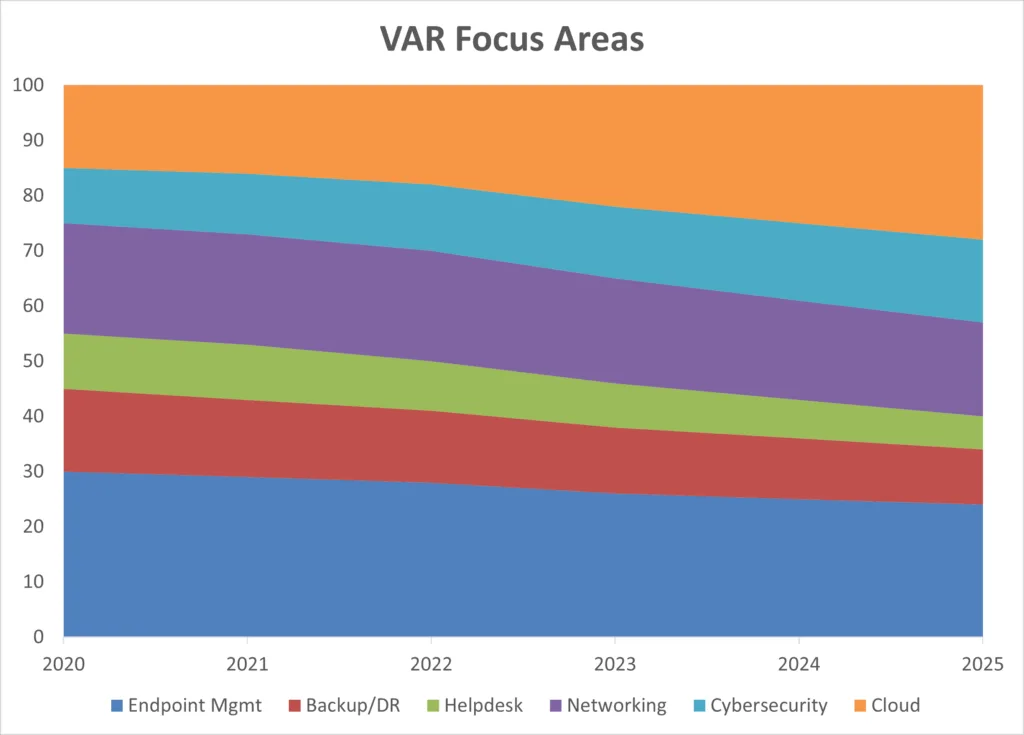
Let’s look at how MSPs and VARs actually allocate their time and revenue across service lines. A visual comparison of 2025 estimates tells the story clearly:

Chart data synthesized from publicly available reports including Canalys (MSP Landscape 2024), CompTIA (State of the Channel 2023–2025), Kaseya/Datto MSP Benchmark Reports, and IDC Partner Ecosystem Forecasts. Figures are directional estimates reflecting market share by service line and are rounded for comparative visualization.

This isn’t just a surface-level difference—it reflects a complete divergence in operating models. MSPs are anchoring themselves in scalable, automated, recurring service delivery. VARs remain largely tied to hardware, implementation, and short-term projects.

Where MSPs are optimizing for margin per ticket and time-to-resolution, VARs are still chasing margin per unit sold and quoting cycles. This graph is less a snapshot than a roadmap—the MSP economy is moving in a fundamentally different direction.

Why Most VARs Didn’t Make It

  1. The Culture Gap: VARs are project-based. They optimize for margin on discrete transactions. MSPs are operational entities. They think in workflows, SLAs, and margin per ticket. That shift isn’t just financial—it’s organizational. And many VARs didn’t want to make it.
  2. The Tech Stack Problem: MSPs build around RMM, PSA, MDM, and now AI-driven automation. VARs, meanwhile, are often stuck quoting hardware and maintaining legacy relationships with distributors. You can’t bolt managed services on top of that stack—you need a replatforming.
  3. The Talent Trap: Great MSPs invest in service delivery talent—L1, L2, and increasingly virtual CIO roles. VARs hire for pre-sales engineering and deal support. The skillsets are different, and so is the hiring motion. You can’t just retrain a sales org to run managed services.
  4. The PE Playbook Wasn’t Enough: Yes, private equity firms tried to MSP-ify their VAR portfolios. Some succeeded. But many just bundled services with no operational integration. They got a few years of EBITDA uplift, but not the long-term transition they expected.

What Actually Happened

So if VARs didn’t become MSPs, what did they become?

The answer depends on how aggressively they evolved:

  • The Bold Few replatformed and built true MSP engines. These are now indistinguishable from born-in-the-cloud players.
  • The Middle Majority added services but remained sales-centric. These firms are being commoditized or acquired.
  • The Legacy Holdouts stuck with project work, hardware, and on-prem support. Many are now losing relevance.

Meanwhile, the MSP segment matured, specialized, and consolidated. We now see:

  • Vertical MSPs with deep IP in healthcare, legal, construction, etc.
  • MSSPs born from MSPs that doubled down on cybersecurity.
  • Platform MSPs that run integrated, repeatable service models across hundreds of clients.

A New Playbook for Vendors

If you’re a vendor with a cloud, SaaS, or hybrid HW/SW portfolio, it’s tempting to cling to the idea that your legacy VARs will modernize into service delivery partners. But that bet isn’t aging well.

Instead, consider this:

  • Segment by Operating Model, Not by History: Don’t ask, “Were they a VAR or MSP?” Ask, “Do they have the systems, people, and incentives to drive recurring service outcomes?”
  • Prioritize Integration into the MSP Stack: MSPs want fewer tools, deeper integration, and automated workflows. If your solution doesn’t plug into their PSA, RMM, or ticketing platforms, you’re just noise.
  • Lean Into Specialization: The fastest-growing MSPs are niche-focused. Help them go deeper: offer compliance bundles, co-branded vertical marketing, or SLAs tailored to end-client needs.
  • Design Programs for Stickiness, Not Just Margin: Margin incentives are table stakes. Design for long-term revenue growth: training, automation, customer success collaboration, and shared account planning.

A 2025 Playbook for MSPs

  • Productize Services: Bundle high-margin, repeatable services (e.g., MDR, compliance-as-a-service) that scale.
  • Automate Everything: Use AI and ML in ticket triage, patching, threat detection.
  • Standardize Stack: Fewer tools, deeper integrations—limit vendor sprawl.
  • Deepen Vertical Expertise: Create proprietary playbooks for specific industries.
  • Co-Manage Strategically: Partner with internal IT teams, not compete with them.
  • Invest in CS + Renewal Ops: Recurring revenue doesn’t renew itself. Customer success drives MRR durability.

A 2025 Playbook for VARs

  • Decide: Reinvent or Specialize: Either replatform into a true MSP or go deep into enterprise project expertise.
  • Bundle + Subcontract: Don’t try to become an MSP overnight. Partner with one and build margin into bundles.
  • Modernize Sales Motions: Sell lifecycle value, not just SKUs. Introduce consumption-based offerings.
  • Align with Cloud & Security: Even if project-based, lead with what clients are prioritizing—zero trust, hybrid cloud.
  • Offload Low-Margin Services: Get out of break/fix, generic helpdesk, and backup unless fully automated.

The idea that VARs are becoming MSPs was a useful bridge story—but it’s no longer true in most cases. Instead of hoping for convergence, it’s time to embrace the divergence. I am never going to eat egg salad, but a nice fried or scrambled egg may make the cut.