Avalara: Winning the category conversation

Avalara: Winning the category conversation

Avalara, the agentic AI leader in global tax and compliance, sought to strengthen enterprise credibility, demonstrate that its AI capabilities were practical and differentiated, and own share of voice within the category. Together, Avalara and Marketbridge launched a bold omnichannel market takeover designed to dominate the category conversation when buyer attention was at its peak. The result: homepage traffic rose 200%, share of voice soared 16% and the campaign delivered more than 70 million impressions with US and UK audiences.

Marketbridge helped us create a campaign that not only elevated Avalara's visibility during a highly competitive period, but also drove engagement with the audiences that matter most to our growth. By aligning brand, demand generation and sales activation around a single strategy, they delivered measurable impact across the funnel while reinforcing our position as a leader in the category.

Winning attention when the market is paying attention

While most awareness campaigns spread investment across long time horizons, Marketbridge took a different approach. Rather than trying to be everywhere all year, the strategy focused on a concentrated “saturated sprint” during Tax Day season—a coordinated market takeover designed to maximize visibility and share of voice when relevance was highest.

The objective was simple: surround buyers with a consistent, unmistakable message across the channels and environments that mattered most.

Avalara work story: Winning attention when the market is paying attention

Bold creative for a crowded market

At the center of the campaign was an intentionally bold creative platform. Avalara’s message focused on being practical, credible and differentiated. Specifically, the campaign highlighted how Avalara’s AI capabilities addressed the real-world complexity of tax and compliance, helping the brand stand apart in a crowded market.

The creative platform was built to be impossible to miss. Avalara’s signature orange flooded premium media environments, event spaces, airports, digital channels, and industry gatherings, creating the feeling that Avalara was everywhere buyers looked. Confident, challenger-minded messaging reinforced the brand’s leadership position and challenged category conventions.

Every execution communicated the same core idea: Avalara wasn’t following the category conversation—it was leading it.

Orchestrating a true market takeover

Strong positioning becomes emotionally resonant when buyers encounter it strategically. We developed a coordinated activation strategy spanning premium media, targeted digital channels, event activations, and high-visibility experiential programs. Executed across 25 media partners and 165 placements in the US and UK, the campaign created a level of awareness that made Avalara difficult to ignore during the most important moment of the year for its category.

Premium media placements appeared across highly respected business and financial publications, including The Wall Street Journal, CNBC, MarketWatch, Financial Times and The Economist. These placements were complemented by programmatic connected television, accounting-focused podcasts and industry newsletters, extending reach into key professional audiences.

Digital activation spanned web, email, social and content channels, ensuring a consistent experience regardless of where buyers engaged with the brand. To further increase visibility, the campaign included airport and inflight advertising, transit takeovers and event-focused activations surrounding major industry gatherings.

Avalara work story: Orchestrating a true market takeover

Turning visibility into measurable market impact

The campaign significantly strengthened Avalara’s market leadership, expanding share of voice while driving measurable commercial impact.

increase in Share of Voice
0 %
increase in homepage traffic
0 %
impressions
0 M+

The campaign translated attention into measurable engagement and pipeline impact. A spike in homepage traffic also indicated heightened interest and consideration among target audiences. The result was more than a successful awareness campaign. It demonstrated that brand investment and business outcomes are not mutually exclusive.

What impressed us most was Marketbridge's ability to connect brand investment to business outcomes.

Category leadership requires more than awareness

In crowded B2B markets, buyers rarely experience leadership and build vendor preference through a single campaign or channel. They experience it through consistent presence, clear differentiation and repeated proof points.

By aligning brand strategy, media activation and demand generation around a unified narrative, Marketbridge helped Avalara do more than increase visibility. Together, we raised expectations for what category leadership looks like, setting a new standard for how tax and compliance brands show up in the market.

Why the best perception wins

Avalara CMO Adrianna Burrows recently spoke with Marketing Week about the thinking behind the brand’s transformation, why perception matters in B2B and how brand investment ultimately needs to connect to commercial outcomes. Read the Marketing Week interview (subscription may be required).

FIS: Cinematic storytelling yields results and recognition

FIS: Cinematic storytelling yields results and recognition

Fintech buyers face a volume problem: too much content, not enough distinction or memorability. FIS, a global financial technology leader, recognized the need to break through with more differentiated storytelling. Together, we concepted, produced and launched a creative video series that would strengthen brand affinity and stand out with decision-makers at 53 of the world’s biggest financial institutions, all while gaining industry recognition in the marketing world.

Moving from strategy to story

FIS has a strong strategic platform in their Money Lifecycle framework, which articulates the way money moves: from at rest, to in motion, to at work. With FIS acting as the connective tissue, every phase works in harmony. The challenge wasn’t defining this story—it was illustrating it in an unforgettable way. We needed to transform a complex enterprise narrative into an experience executives would choose to watch, enjoy and share.

Keywords:

Lights. Camera. Money.

We concepted and produced a three-part episodic video series, each film opening a metaphorical “door” into a distinct phase of the Money Lifecycle. Cinematic live action, stylized animation and immersive sound design brought abstract financial concepts into sharp, human focus. A single on-camera narrator delivered direct monologues, guiding viewers through the interconnected worlds of Money at Rest, Money in Motion and Money at Work. Motion graphics created a cohesive visual language across the series and helped articulate the story and keep viewers engaged.

Multi-channel orchestration amplifies the story

Strong creative demands strong distribution that gets the right eyeballs on the work at the right time. We surrounded senior decision-makers at 53 strategic accounts with a coordinated program across LinkedIn, programmatic display, native placements and outbound email. Every element—from video player UX to follow-up messaging—was designed for a frictionless infotainment experience. Each film reinforced the last, deepening familiarity with the Money Lifecycle narrative across buying groups. Each touchpoint drove to a dedicated landing hub featuring the full series. Episodes rotated individually and collectively to encourage repeat visits and sustained engagement.

FIS: Cinematic storytelling yields results and recognition image

The Money Lifecycle campaign exemplified the power of strategic orchestration—leveraging multi-channel, multi-touch engagement to drive measurable impact across the client journey. From awareness to conversion, every touchpoint was intentional, leading to improved engagement and positive movement in pipeline performance.

High-quality storytelling drives 100% engagement

When cinematic storytelling meets disciplined execution, results follow. All 53 strategic accounts engaged with the content. The series generated 7M+ impressions and 6,500+ clicks, driving sustained attention and measurable pipeline momentum among FIS’ most valuable institutions.

strategic accounts engaged
53
impressions
7 M+
clicks
6500 +

This hyper-targeted campaign not only elevated awareness but also sparked meaningful engagement with our most strategic clients. It’s a testament to the power of data-driven creativity and shared vision.

Recognized for raising the bar on creativity

“The Money Lifecycle” video series was named a Webby Honoree for B2B Branded Content in the Advertising, Media & PR category at the 30th Annual Webby Awards. Hailed as the “Internet’s highest honor” by The New York Times, The Webby Awards, presented by the International Academy of Digital Arts and Sciences (IADAS), is the leading international awards organization honoring excellence on the Internet.

Honorees like Marketbridge and FIS are redefining what’s possible on the Internet, pushing creativity and innovation forward in bold and unexpected ways.

Storytelling that performs is the standard

By bringing cinematic craft to enterprise fintech, we helped FIS turn a strategic framework into a compelling creative experience—one that earned attention, drove engagement and reinforced the brand’s central role in the Money Lifecycle. For complex B2B brands, the takeaway is simple: when you treat your audience like viewers, not targets, you drive brand impact and advantage. And that’s a standard worth standing behind.

FIS: Building editorial authority worldwide

FIS: Building editorial authority worldwide

Global financial technology leader FIS needed to make its new positioning unmissable to C-suite decision-makers across eight global markets — and drive measurable brand lift at the highest levels. Together, we launched a thought-leadership blitz with top-tier publishers that married scale with surgical precision to embed the brand in the world’s most trusted editorial voices. The campaign delivered exceptional lifts in awareness, favorability, consideration and trust, setting a new standard in the financial services industry.

In B2B, trust is the new currency. And trust has to be earned. To earn the attention of top fintech decision-makers, we embedded deep FIS executive thought leadership where they seek insights — in the world’s most trusted business media. The result? Engagement was off the charts, and trust in FIS soared double digits.

Engineering editorial authority

Our mandate was to turn brand repositioning into editorial authority that translated to trust. Rather than product-driven messaging, we walked the talk and led with executive voices — activating twelve leader-authored articles on finance, AI and digital transformation, tackling the timely, high-stakes topics shaping the industry. Placements spanned top global business platforms, reaching the audience where they actively seek innovation. Each execution tied back to FIS’ positioning, “Bringing the World’s Money into Harmony,” making the promise visible and credible at every touchpoint.

Orchestrating attention at scale

The campaign rolled out across seven premium partners: LinkedIn, AdDaptive and five tier-one publishers — Bloomberg, WSJ, FT, The Economist and Forbes. Assets were sequenced across digital video, programmatic and sponsored content, driving to a dedicated landing page that maintained cohesion across the campaign.

When attention becomes trust

Authority-driven placements and cumulative exposure delivered extended time-on-page and strong video completion rates. A LinkedIn Kantar study confirmed major brand lift at the highest levels of the market:

trust
+ 16.4 %
brand awareness
+ 13.5 %
favorability
+ 9.5 %
consideration
+ 12.9 %

AI and Digital Transformation content achieved a 1.17% CTR — four times benchmark. Video completion rates topped 55%. Across key content themes — including Core Banking and Digital Solutions — performance exceeded expectations by 60–75%. Risk-focused content on WSJ and Bloomberg beat CTR benchmarks by 160% and time spent by 40%. These results reflected not just visibility gains, but measurable increases in credibility among senior decision-makers.

Brand trust fuels market advantage

This campaign demonstrates the power of shifting the role of brand from one of support to one of true commercial impact. By leading with executive voices and embedding FIS within the most credible editorial platforms, we helped transform repositioning into trust and market momentum. Media investment became lasting brand equity — elevating FIS to must-watch authority in global finance. “Bringing the World’s Money into Harmony” moved from promise to proof in the environments C-suite leaders trust most—positioning FIS for sustained leadership in a trust-driven B2B market.

Your dashboard isn’t the problem

Why financial services leaders keep hesitating (and what high performers do differently)

This conversation isn’t for analysts. It’s for the leaders sitting in the room where the decision stalls, and the ones expected to figure out why.

Assume your team had a strong quarter for data. Intent signals are up. Engagement scores look healthy. The CRM is populated. Account lists are scrubbed. Demandbase is surfacing real buying activity. You have more signals than ever.

So why is everyone still waiting for someone else to make the call?

The real bottleneck isn’t your stack

Here’s the uncomfortable truth: your data problem usually isn’t a data problem.

Financial services organizations have spent years modernizing platforms, expanding reporting, and layering in third-party intent signals. The investment has delivered visibility. What hasn’t kept pace is what happens after the signal arrives.

Most commercial teams already have the inputs — CRM history, marketing automation data, account engagement, intent feeds. What they lack is a shared framework for translating those inputs into coordinated action. Sales reads the signal one way. Marketing reads it another. Compliance hasn’t been asked yet.

More visibility does not automatically create more confidence. It often creates more friction (and more meetings).

If you’ve been in financial services for a while, you’ve seen this pattern before.

The internet reshaped distribution. CRM reorganized account management. Marketing automation formalized execution. Predictive models refined targeting. Each time, technology advanced rapidly. The operating model moved … eventually.

The pattern is consistent: tools arrive, teams interpret them differently, friction sets in, someone calls a working group, six months pass. Friction is not about innovation appetite. It’s about alignment. And, in regulated environments, alignment is especially hard to rush.

Signal intelligence is the latest chapter. The technology is genuinely better. The organizational challenge is genuinely familiar.

The perfection trap

In regulated industries, caution is rational. No one wants to act on flawed data or defend a misstep to legal. So, teams wait for the data to be cleaner.

The problem is that “clean enough” keeps moving. Modernization projects extend. Validation standards shift. Meanwhile, account behavior doesn’t pause. Buying signals surface regardless of your data environment being immaculate. Competitors make decisions with imperfect information and win.

Most financial services organizations already have enough signal to improve prioritization. The difference is that high-performing teams define what “good enough” means, get compliance comfortable with it, document it, and move.

Confidence doesn’t always come from better data. Sometimes it comes from clearer rules.

One account. Too many narratives.

Here’s a scenario that will feel familiar.

Marketing sees elevated engagement and flags an account as warm. Sales isn’t hearing urgency from the relationship and questions the signal. Analytics surfaces third-party intent suggesting early-stage research. Compliance wants to understand what outreach is being planned.

All four functions are working with valid information and none agrees on what to do next.

This is not a technology failure. Demandbase is doing exactly what it should — centralizing signal and surfacing account-level intelligence. The failure is interpretive. Without shared prioritization criteria, each team builds its own narrative. Coordination becomes negotiation and pipeline velocity becomes the casualty.

The solution isn’t a better dashboard. It’s alignment.

  • What constitutes a meaningful signal?
  • What confidence threshold justifies outreach?
  • Who owns the decision?
  • When is compliance engaged?

One account should generate one plan.

Structure first, scale second.

The organizations that move effectively don’t start with activation. They start with alignment.

Sales and marketing agree on what a “ready” account looks like — operationally, with documented thresholds and visible logic. Legal and compliance are involved in designing prioritization frameworks, not reviewing decisions after the fact. Platforms like Demandbase support that alignment by creating a shared account view across commercial teams.

When prioritization logic is transparent and defensible, review cycles shorten. Trust builds. Activation accelerates.

Sales/marketing alignment earns credibility in the field. Compliance alignment earns confidence at the board level. Together, they make scale possible.

Without them, scale amplifies chaos.

Technology surfaces insight, structure makes it usable.

Sophisticated signal processing in a misaligned organization doesn’t solve the problem. It makes the arguments louder.

The financial services leaders who adopt new capabilities effectively aren’t ignoring the rules. They’ve done the alignment work to operate confidently within them. They’ve defined what signal means. They’ve agreed on who acts. They’ve made the prioritization logic explainable — to their teams, their boards, and, if necessary, a regulator.

Explainability isn’t a constraint on performance. It’s a prerequisite for it.

What comes next

There is no shortage of signals in financial services. There is a shortage of shared interpretation.

The organizations that outperform aren’t the ones with the most data. They’re the ones that have decided — together, across sales, marketing, and compliance — what to do with it.

In the on-demand webinar — Boardroom-ready AI for financial services marketing: Turning signals into confident GTM decisions — Marketbridge and Demandbase go deeper on the operating model patterns that separate high-performing financial services teams from the ones still negotiating over dashboards. We explore the governance and decision-rights frameworks that allow signal-led approaches to stand up in front of boards and regulators, not just commercial teams.

If any of this feels uncomfortably familiar, that’s probably a good reason to check out the on-demand webinar.

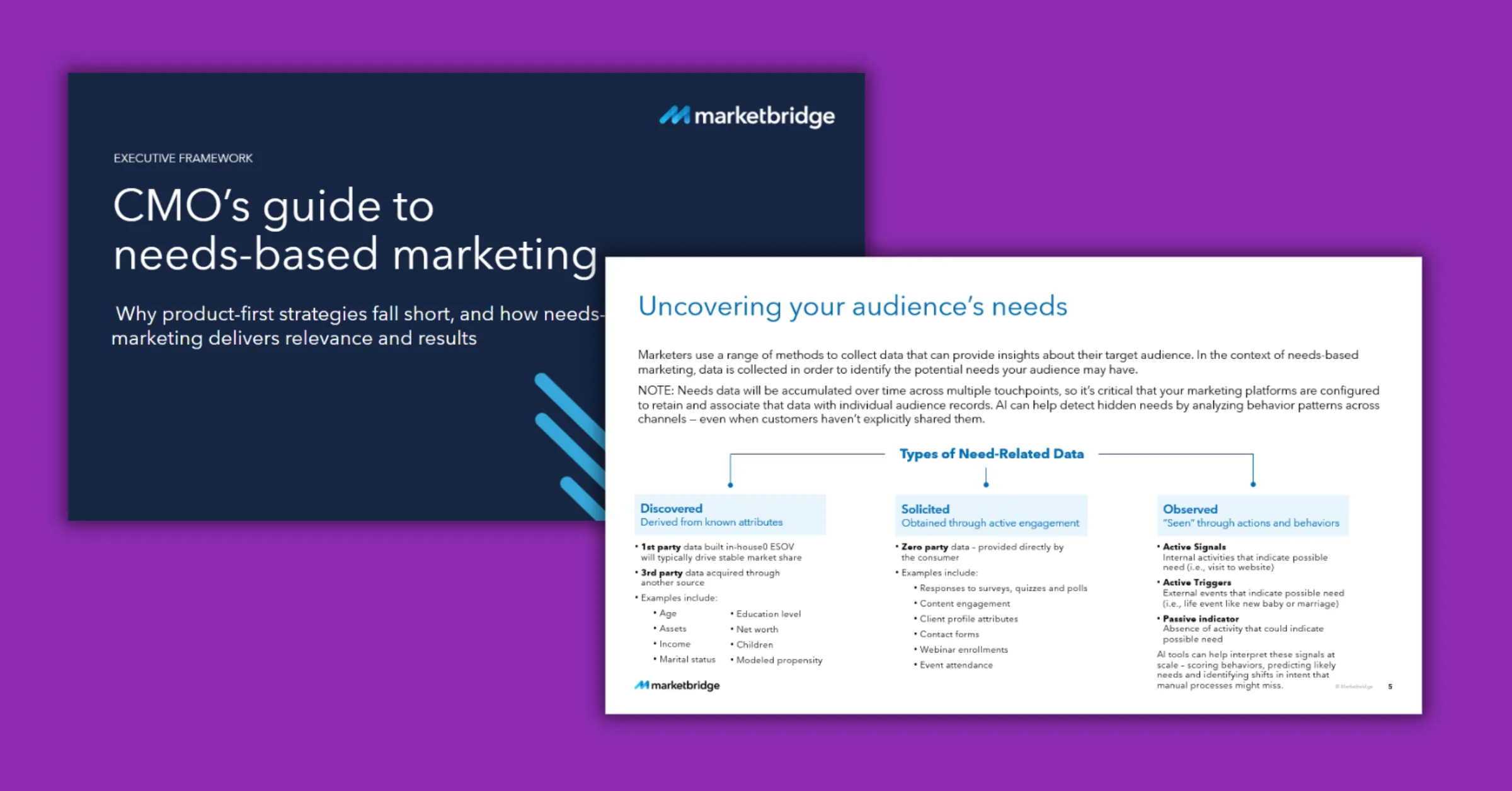
CMO’s guide to needs-based marketing

CMO’s guide to needs-based marketing

Why product-first strategies fall short and how needs-based marketing delivers relevance and results

Marketers are under pressure to create more relevant, personalized experiences. Too often, the focus begins with the product instead of the buyer. Needs-based marketing offers a smarter approach by prioritizing customer needs, supported by AI, and activated through automation. This guide uncovers evolving motivations and helps align strategy and content with intent, ultimately creating more relevant journeys that lead buyers to the right solution at the right time.

Download the guide to learn how to: 

  • Anticipate and uncover real customer needs beyond demographics and personas
  • Leverage AI and automation to detect needs earlier and scale more flexible, and personalized journeys
  • Introduce product messaging at the right time,not every time
  • Build internal alignment for a needs-first approach across teams
  • Deliver content aligned to evolving motivations and behaviors

What’s next?

Five ways a CDP can help financial services marketers

Marketing leaders in financial services are navigating a long list of expectations: personalizing communication, improving acquisition performance, retaining customers, and demonstrating returns. And yet, for all the investment in technology and talk of “data-driven” strategies, many marketers still struggle to access the data they need to do the job well.

Customer Data Platforms (CDPs) were introduced to address the need for the comprehensive, multi-channel data necessary for modern marketing. For many organizations, these solutions provide helpful structure around audience segmentation and campaign targeting. But traditional CDPs are built with fixed logic. They assume a degree of centralization and integration that most financial institutions simply do not have – and often require marketers to adapt to the software, rather than the other way around.

That’s why I believe composable CDPs (sometimes referred to as go-to-market data lakes) are a better fit. They allow marketing, analytics, and technology teams to assemble a flexible data foundation that works across existing systems. Instead of being forced into someone else’s box, you get to design the system around your own business needs. And in an industry with complex products, legacy infrastructure, and heightened regulatory expectations, flexibility matters.

Here are five ways a composable CDP can help:

1) Align Marketing, Analytics and Tech Around Shared Goals

One of the biggest challenges I see in financial services is that marketing, analytics, and tech teams operate in their own ecosystems and still speak different languages. They’re doing good work, but often on different timelines, with different priorities and different definitions of success. Marketing focuses on strategy and outcomes, analytics is buried in reporting and data engineering, and tech is managing capabilities and infrastructure. When those groups aren’t working from a shared roadmap, priorities get misaligned quickly.

A composable architecture helps bring those teams together. When you organize around specific use cases – like onboarding new customers or identifying upsell opportunities in the advisor channel – it’s easier to stay aligned. Everyone understands what they’re building and why. That cuts down on back-and-forth, reduces wasted effort, and improves speed to market.

A composable architecture also helps reduce cost. Anyone who’s worked through multiple rounds of rework knows how expensive it can be to get it wrong. This approach minimizes that risk.

2) Tame Data Complexity from Mergers and Legacy Systems

Most financial institutions aren’t starting from a clean slate. They’ve grown through acquisitions. They manage multiple product lines and deliver through multiple distribution channels. And they often rely on infrastructure built over decades – which means customer data lives across dozens of antiquated systems, none of which were designed to talk to each other. Add in a wide range of state- or account-level variations and compliance requirements, and you’ve got a perfect storm.

Trying to shoehorn all of that into a single CDP can be painful and expensive. Composable CDPs work differently. They allow you to connect the systems you already have, extract what matters, and standardize the data just enough to activate it. You don’t have to rebuild everything. You can move forward with what’s useful and gradually evolve from there.

This is particularly helpful when you’re trying to deliver consistent experiences across business lines or channels that weren’t originally designed to coordinate. A composable approach makes that achievable.

3) Protect Customer Trust While Meeting Regulatory Demands

Another big reason this matters in financial services? Regulation. Privacy and compliance are non-negotiable and a marketing data strategy that doesn’t fully account for them will eventually fail – if not operationally, then reputationally.

A composable CDP can help on both fronts. It provides structure for managing consent preferences, documenting data lineage, and making sure sensitive data isn’t used out of context. It gives compliance teams the transparency they need, while still giving marketers the ability to move with speed.

You don’t have to choose between responsible data practices and effective marketing. With the right setup, you can do both.

4) Move Beyond Guesswork and Test Like Scientists

Many marketing teams want to build a culture of experimentation; however, in financial services, it can be a struggle to run tests that meet both business and regulatory standards. Whether you’re optimizing retirement planning campaigns or fine-tuning service reminders for lapsed policyholders, experimentation can feel risky without the right controls.

A composable CDP changes the game. It gives you access to real-time data across systems, supports test design, and makes it easier to track and optimize performance in a way that stands up to internal scrutiny. This doesn’t just improve outcomes – it improves credibility and trust with the rest of the business. When marketing shows up with results instead of opinions, it becomes easier to justify budget, ask for resources, and lead with confidence.

5) Scale Personalization That’s Actually Useful

Personalization is important, but only if it’s meaningful. Sending someone their first name in a subject line doesn’t move the needle. However, a needs-based approach that allows you to recognize that a young family is saving for college, or that a retiree is reevaluating their drawdown strategy, actually might.

A composable CDP helps you make that leap. It enables you to respond to intent-based behaviors, engagements, signals, and life events—so that you can serve the right message at the right time. And because it’s connected across systems, you’re not guessing. You’re making decisions based on what people are doing, not just who you think they are.

Done right, this builds trust. Customers begin to expect, and appreciate, that your outreach makes sense given their situation.

Getting a handle on this is 100% doable

I’ve worked in financial services long enough to know how hard all of this can be. The systems are fragmented. The expectations are high. And the time to show results is always shorter than anyone would like.

But I’ve also seen what’s possible when marketing, data and tech teams come together around a common strategy. Composable CDPs don’t eliminate the complexity, but they make it manageable. They provide the architecture to move faster, plan smarter and execute with greater clarity.

At Marketbridge, we help financial services organization build these kinds of systems. We’ve got both the technical and industry expertise to help connect strategy to architecture, marketing to analytics, and data to decisions.

If you’re navigating disjointed infrastructure, dealing with legacy or disparate systems, exploring how AI fits into your stack, or just trying to modernize the way your team operates, we’d be glad to share what we’ve learned. Let’s talk.

Download the whitepaper, “Building a composable go-to-market data stack”​

Rethink your data foundation and lead the next era of AI-ready, insight-driven marketing.

The hidden costs of siloed ecosystem

The employee benefits market is highly complex and rife with inefficiencies. On the path between providers and customers lie brokers, software platforms, and HR departments, to name a few, each with their own priorities and costs. With every intermediary taking their cut–whether from commissions, service fees, or administrative overhead–over a third of the premium dollar may be lost to non-coverage-related spending.

The persistent margin leaks

Unfortunately, the inefficiencies within the benefits market are not a new problem–and innovation in the industry has been largely stagnant over the past decade. Perhaps due to the difficulties stemming from high complexity and regulation or the lack of sufficient data integration leading to silos, benefits have not seen the innovation that other financial services industries have.

But advancements are long overdue. Benefits companies must decide how best to streamline the ecosystem between carriers and beneficiaries without compromising overall effectiveness to lead in this industry in the coming decade.

Mitigating inefficiencies in the benefits ecosystem

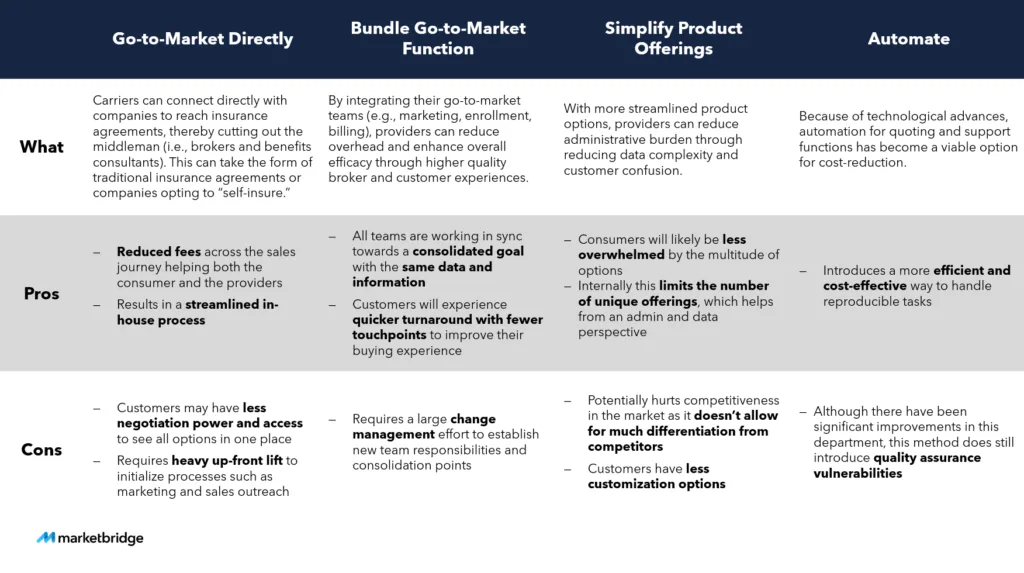
Providers have a variety of avenues through which to streamline their go-to-market process and offerings:

Leveraging a team dedicated to the innovation of the benefits ecosystem will facilitate a more painless integration process, regardless of approach.

Innovating towards a consolidated future

In an industry bogged down in complexities and intermediation, heightened integration is key, and there hasn’t been a better time than now. Technology is more capable than ever, including more powerful AI and more complex software integrations. Companies that can establish streamlined processes that limit margin leaks without degrading consumer value will remain relevant in this highly competitive industry.

For more information on how providers can innovate their go-to-market strategy to be strong players in the employee benefits space in the coming decade, read our whitepaper: “A new golden age for employee benefits.”

Download the whitepaper, “A new golden age for employee benefits”​

Discover how GTM leaders can cut through complexity and unlock growth.

Intentional AI use for employee benefits marketers

Artificial intelligence is a tool that can unlock immense efficiencies within the employee benefits space. In this blog post, we discuss and provide examples for 3 areas of AI utilization within the employee benefits go-to-market space:

  • AI for acceleration: using AI as an ad-hoc tool for employee productivity
  • AI for insights: using AI to extract summary statistics from large sets of unstructured data
  • AI for workflows: integrating AI directly as features of the product or service

However, despite the promises of productivity and scalability for employee benefits organizations, users of AI should not replace their human intuition or creativity with AI automation. Hallucinations still pose a large barrier to full-scale automation of workflows, while AI-generated content lacks the “human empathy” needed to generate trust and connect with human audiences. Therefore, the core use-case for AI today is as a tool to enhance one’s own productivity, but not as a replacement for creative minds and product builders.

AI for acceleration

Content and product creation is the core example of using gen AI to accelerate the go-to-market process.

  • Streamlining Data Transfer: AI agents can automatically scan benefits enrollment and claims data and insert relevant qualitative details into each employee’s profile. We recommend the first step towards this implementation include efforts for building thorough and clean data for employee, lead, and account profiles which can be leveraged towards these AI-driven campaigns.
  • Personalization at Scale: In the B2B go-to-market space, gen AI is being used to produce emails with hyper-targeted value propositions based on a lead’s personalized profile; AI models can ingest past email interactions with a sales lead and draft a personalized email for relevant benefit plans based on these past interactions.

Fundamentally, AI’s principal utility is the ability to offload the burden of rote repetitive tasks onto the computer, allowing the user to focus on optimizing marketing and sales efforts through creativity and insights.

AI for insights

Large language models (LLMs), and more specifically Retrieval Augmentation Generation (RAG) models, can automate the finding, ingestion, and summarization of large volumes of texts. Some examples include:

  • Document Summaries: If desktop research has uncovered a 20-page document (e.g. quarterly financial reports), AI can now summarize those findings. A metric like employee headcount can be critical in estimating the growth of an account or value of a prospective client; and is easily summarized for each company through AI.
  • Extraction From Unstructured Data: AI can also quickly generate summary statistics from a large database of first-party unstructured data. A RAG model can be used to answer questions like, “how often do our leads mention some form of retirement benefits in emails during the sales journey?” or “what are the most common questions asked during member service calls?”

The ability to generate such summaries and statistics allows analysts to focus on interpreting the numbers, instead of the manual labor of compiling them.

Download our report, “The impact of AI on Go-to-Market strategies, programs, and investments”​

AI for workflows

The ability to embed AI agents in a network of connected software systems allows such AI agents themselves to become directly embedded into workflows of a product or service.

  • Account-Based Marketing: AI agents can produce recommendations to optimize account-based marketing (ABM) campaigns. By scanning the entire ecosystem of accounts, leads, contacts, and opportunities, AI agents can rank accounts by likelihood to convert, renew, or churn. AI agents also can recommend messaging sequencing
  • Concierge Services: AI agents can field and reply, in real-time, to questions asked by employees regarding benefits and aid in the selection of insurance plans and retirement contribution amounts. As well, AI agents can help members make enrollment changes during qualifying events, and even answer questions about what qualifies as a life event.

Implementations of such core features could become table stakes for employee benefits organizations in the near future.

Limitations of AI

Despite the vast potential advantages that AI holds, there are still potential weaknesses which must be understood and considered when utilizing AI’s services, including:

  • Non-existent Sources: AI agents can sometimes cite non-existent and completely fabricated sources that sound like they should exist. This often happens when users ask leading questions to AI agents: “Why does Singapore have a larger GDP than the United States?” Our recommendation is to use AI to summarize information and then double-check the relevant sources.
  • Plan Fabrication: If an enrollee is comparing benefits plans, an AI agent could fabricate plan details. For example, an enrollee might ask: “If I make $X each month, why is Plan A better than Plan B?”. In this instance, the AI agent might claim that: “Plan A is better because it is cheaper than Plan B” when Plan A is actually more expensive than Plan B. LLMs developed by mature AI organizations have found huge success in mitigating these kinds of logical reasoning errors, so our recommendation is to use a mature product offering from an industry leader, rather than a homegrown solution.
  • Lack Of Human Empathy: AI-generated content (both text and images) often come with an “uncanny valley” effect; the content feels sterile, generic, and disconnected from a human audience. In fact, 91% of organizations with over $50 million in revenue do not feel prepared to implement AI with the necessary safety and responsibility (Mckinsey). Our recommendation is to use AI as a jumping off point, and have smart marketers customize the copy to make it real, human and effective.

Ultimately, AI agents generate what they believe the user wants to hear and not what is necessarily factually correct. AI’s untrustworthiness leaves it incapable of owning specific insight generation and workflows without oversight. Therefore, it is still imperative that users of AI do not rely on it for items which require critical thinking, though the employee benefits space can leverage this powerful tool for acceleration, workflow and the early stages of insights generation.

What other bold moves should benefits leaders make to compete in the coming decade?

Download the whitepaper, “A new golden age for employee benefits”​

Discover how GTM leaders can cut through complexity and unlock growth.

Benchmarks to blueprint: How financial services marketers can elevate marketing execution

Benchmarks to blueprint: How financial services marketers can elevate marketing execution

Can modern marketing thrive under tighter budgets and higher expectations?

In a time of budget scrutiny and operational strain, marketing leaders are facing a new challenge: deliver more measurable results with fewer resources. In financial services and beyond, marketing spend is declining as a percent of revenue—yet digital performance channels are still growing. The message is clear: every dollar must count, and every tactic must be accountable.

This whitepaper explores how high-performing marketing teams are shifting from reactive cost-cutting to proactive performance building—using data, automation, and strategic alignment to drive real results.

In this paper we cover:

  • Why spend is shifting, not disappearing: Understand how high-performing marketing teams reallocate budgets toward measurable, digital channels.
  • A blueprint for better execution: Practical steps to close the gap between strategy and delivery.
  • The role of AI and automation: How elite teams gain speed and scale without sacrificing control.
  • Real-world results: See how one team saved millions by rethinking how work gets done—from reducing ad hoc demand to fixing creative resource strain.

Access the paper to rethink how your marketing engine performs under pressure.

The age of the non-technical benefits marketer is over

The modern benefit admin ecosystem is a sprawling system defined by fragmented channels, complex integration paths, and deeply regulated products. For the proactive benefits marketer, staying on top of this rapidly evolving playing field requires a toolkit of integrated analytic and technical capacities. Those who fail to adapt will quickly find themselves falling behind. Winning in this space requires marketers to adopt three approaches that enable smarter, data-driven execution.

1) Making go-to-market a data-driven discipline

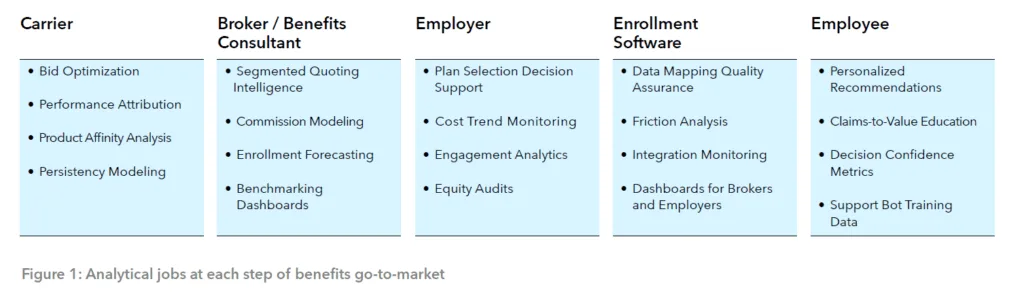
In the modern financial services environment, a successful marketer is part analyst, part growth hacker, and part systems architect. Cutting-edge marketing strategy aims to measure incrementality, test and re-test creative performance, gauge audience potential, and understand channel-specific ROI. All of this must be continuously optimized. In the Ben Admin space, this means tracking the entire benefits choice lifecycle and working closely with sales teams to segment targets, pursue account-based sales strategies, and bring the right content to the right buyer at the right time. At Marketbridge, we take a use-case based approach to simplify this process into a series of “jobs to be done” for a quantitatively robust go-to-market strategy (Figure 1).

2) Micro-segmenting groups

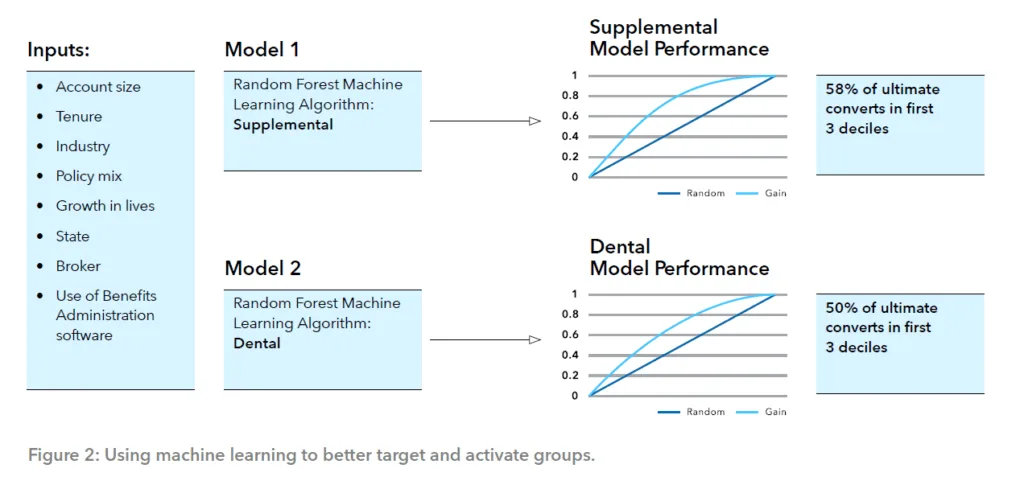
It is now possible to build segmented activation strategies not just by employer size and geography, but also by industry vertical, renewal cycle, benefit portfolio, and even internal HRIS configuration. Strategies utilizing machine learning techniques can create targeted activation based on factors such as account size, tenure, industry and policy mix. In the example below, these factors were used in a random forest model to score groups for marketing activation during the open enrollment period, and half of all converters were accurately predicted by the top 3 deciles. This allowed for more targeted and efficient marketing activation and conversion strategies across the funnel (Figure 2).

3) Remixing digital channels for real enrollment lift

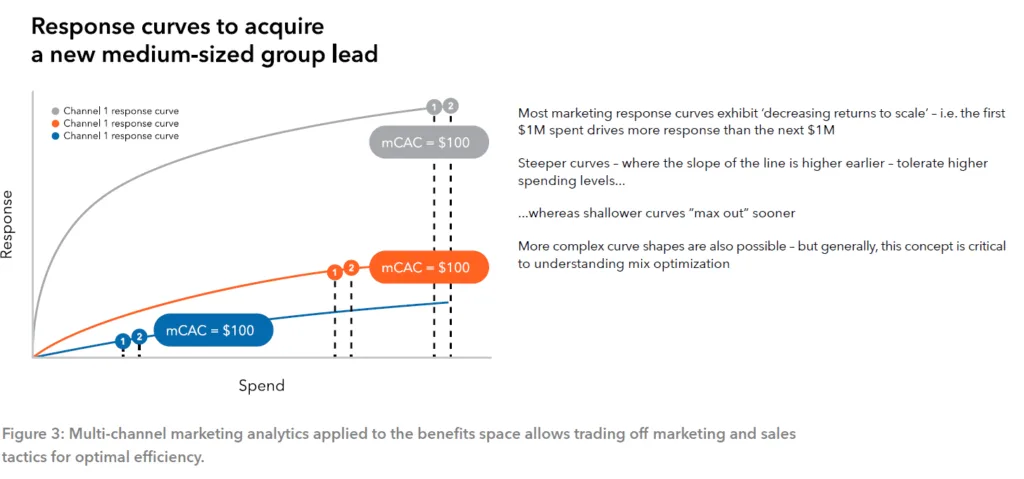
Employee benefits marketing must now account for the complete activation and retention funnel, requiring fluency across multiple digital channels and the ability to test channel mix optimizations in all stages of the buying cycle. Techniques like MMM (media mix modeling) and MTA (multi-touch attribution) can determine which tactics and channels drive groups and employees towards decisions, and powerful open-source data science libraries make these methods accessible to anyone with data. In Figure 3 below, the output from a typical MMM shows how three different channels reach the same CAC (customer acquisition cost) at very different spend levels—implying an optimal mix for maximum effectiveness and efficiency.

Why this matters

The benefits market is still highly competitive, but this won’t last forever. Carriers and brokers still operating with a traditional marketing mindset will find themselves increasingly left out of bids, while those willing to modernize their marketing and sales teams will rise to the top. The next generation employee benefits marketer won’t be “digital” in the superficial sense—they’ll be technical, data-fluent, and operationally embedded across the entire go-to-market stack.

Download our whitepaper, “A new golden age for employee benefits”​

Discover how GTM leaders can cut through complexity and unlock growth.