Graebel: Proving “people first” is second to none

Graebel: Proving "people first" is second to none

Throughout its 70+ year history, Graebel has maintained a reputation for authenticity and high-touch service. Its brand promise, “people-first mobility,” is true through and through. Yet, in early 2023, a key competitor was beginning to look and sound a lot like Graebel. This ABM campaign proved that a brand is more than skin deep and that Graebel’s people-first mobility promise is second to none.

Using ABM to show you’re un-copycat-able

Well beyond a logo or tagline, brand is how a company shows up in the world, how it approaches challenges and how it delivers on its promises. Graebel, a leading global relocation management company (RMC), has been uniquely living its people-first mobility belief—and brand—for decades. But lately, it seemed like everyone (including a large, key competitor) was jumping on the “customer-centric” bandwagon—and Graebel had something to say about it.

Through the ABM program, we needed to make clear that people-first mobility with Graebel is not just a surface-level claim. It’s a promise. Following a thoughtful ramp-up that included a Martech Stack Audit, ABM Readiness Assessment, Martech Roadmap and Sales and Marketing internal alignment and buy-in, we launched a 1:Few program targeting 62 accounts that had existing contracts with or were displaying intent toward this key competitor.

Preparing the roadmap

With multiple decision makers in the mix, we needed to fire on all cylinders—channel, content, creative and tech strategy—to differentiate Graebel and plant seeds of doubt against our competitor. Working closely with the Sales team, we identified our target accounts. We assessed the health of account and contact data in Graebel’s database leveraging Demandbase and RampedUp while also acquiring contacts using SalesIntel to ensure we adequately covered the buying syndicate.  

To maximize reach and engagement, we planned online and offline touches coming from both Marketing and Sales. Content and creative would need to be clutter-busting, insightful and resonant. And martech would need to undergird everything, helping orchestrate and automate a complex program with ease. 
An unwavering creative concept

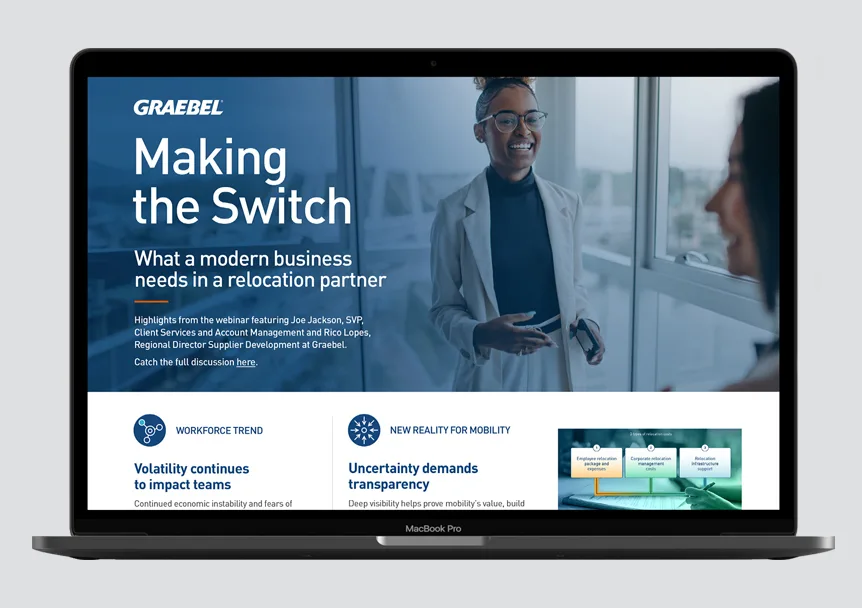
With competitors evolving toward more customer-centric positioning and messaging, the apparent contrast between them and Graebel was diminishing. But people-first mobility is more than skin deep, and Graebel had a set of values and ways of conducting business that were 100% un-copycat-able. Our creative needed to affirm our strengths and challenge assumptions without slinging mud at competitors—because that would be so un-Graebel.

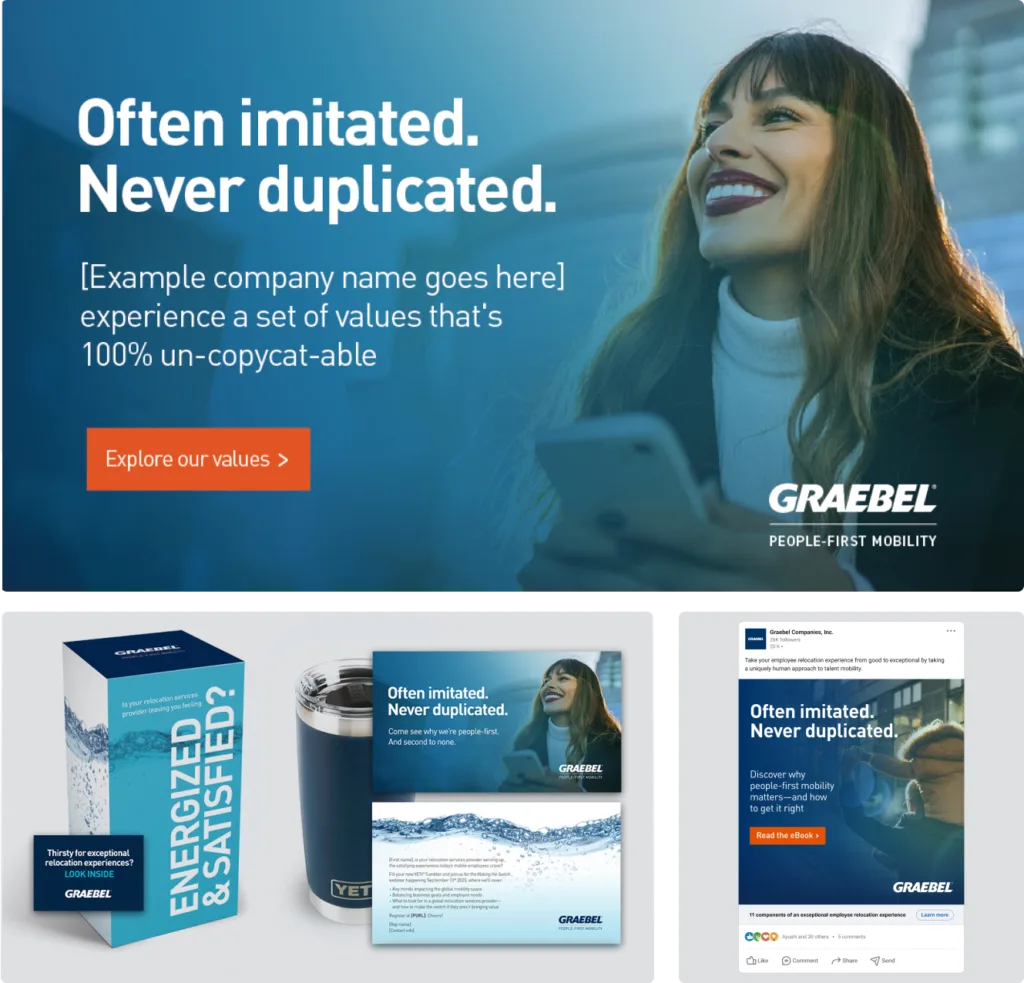
The resulting concept was undeniably on brand but with a proud and polished swagger. The campaign headline that anchored all creative assets (“Often imitated. Never duplicated.”) made clear that while others may waffle or overpromise, Graebel maintains an unwavering focus on people-first mobility.
A people-first program

We developed an ambitious, multi-channel, multi-touch campaign that spanned three phases over several months.

Aware

The Awareness phase was about getting on the radar and planting seeds of doubt. Through email (deployed via Pardot), content syndication and LinkedIn, educational content on global mobility trends and creating exceptional relocation experiences took center stage.

Engage

The Engage phase was all about nurturing the relationship. Inbound activity through personalized Demandbase display banners and LinkedIn paid social drew audiences into the campaign story, while outbound email linking to Uberflip-hosted landing pages sent key messages out. A Drift custom chatbot encouraged direct Sales outreach.

The nexus of activity was an industry expert-led, Zoom-hosted webinar. Contacts were sent a personalized direct mail gift that invited them to attend an insightful discussion on the criticality of people-first mobility—and how to begin making the switch if they’re dissatisfied with their current RMC. By integrating Zoom with Pardot, we were able to then surround registrants and attendees to the webinar with Sales and Marketing reminder emails and branded follow-up content.

Connect

The Connect phase aimed to secure Sales conversations with highly engaged contacts. Sales took the lead by sending a personalized video via Drift and LinkedIn InMail. Marketing emails supported the program with bottom-of-funnel, credibility-building content.

An ABM victory

Within three months, we achieved 98.4% account engagement and 36% conversion through new contact information acquisition. What’s more, as a direct result of the ABM campaign, active sales opportunities, representing millions in potential revenue, are in motion. By staying true to their brand and following foundational ABM practices like smart targeting, savvy orchestration and strong creative, Graebel proved that “people-first mobility” belonged to them and them alone.

0 %

Accounts reached

0 k
Net-new contacts acquired
0 %

Account engagement

0 %

Account conversion

$MM

In Pipeline

“We’ve been on a journey to experiment with ABM. 

Working on this campaign with the Marketbridge team has validated how powerful account-based can be as a GTM motion, when done right. It was a really big deal for us, and I couldn’t be more thrilled with what we’ve achieved together.” 

– VP, Global Marketing | Graebel

3 channel partner challenges hindering your revenue growth

With the tech economic slowdown likely extending into 2024, businesses must adapt their resources, budgets, products, and partners to the new selling environment. As buyers delay large transactions, subscription services that are cost-efficient or vital to daily operations (like SaaS for payroll) will gain prominence. Given tech firms’ reliance on channel partners to seize market opportunities and deliver value-added services, companies must ensure their partners can effectively develop and sell new Anything-as-a-Service (XaaS) solutions.

Our direct client feedback and survey responses revealed that partners often struggle to adapt customer experience and solutions to embrace new XaaS-driven revenue streams. In the pursuit of XaaS success, tech leaders face three prevalent channel partner challenges:

  1. Misaligned Go-to-Market Objectives
  2. Unmet Service and Delivery Expectations
  3. Lack of Data-driven Engagement Models

1) Misaligned Go-to-Market Objectives

Swift pivots to XaaS models can result in inconsistent and confusing partner strategies and programs. Whether due to a lack of strategic vision or a lack of partner communication, it’s not uncommon to find a company trying to run two partner program “flavors” at the same time—one for traditional on-premises sales (which might be a large legacy revenue stream) and another for XaaS selling (which has different channel partner program characteristics). Businesses that haven’t thought through where XaaS revenues will come from and which partners are best positioned will struggle to grow.

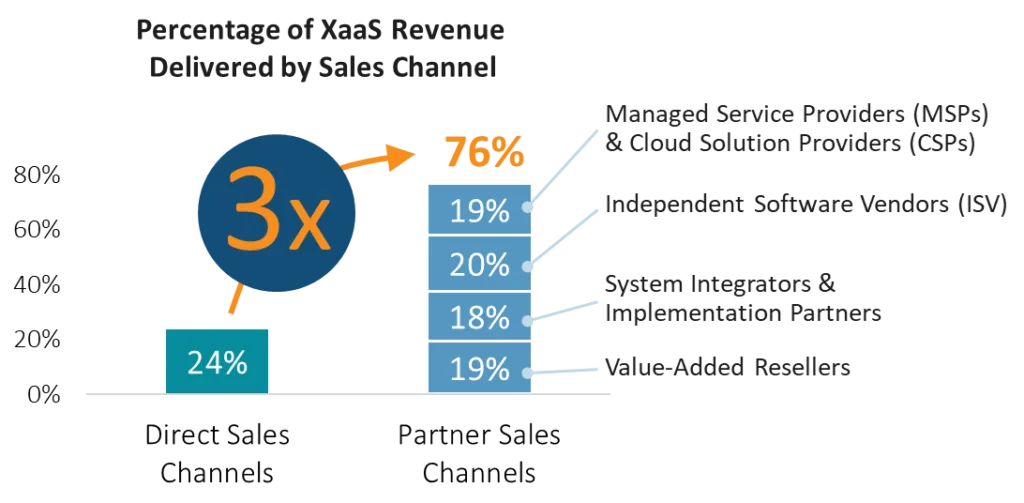
Partner sales channels deliver 3x more XaaS revenue than direct sales channels (Figure 1), but not all partners are created equal when it comes to XaaS suitability. Managed Service Providers (MSPs), Cloud Solution Providers (CSPs), and Independent Software Vendors (ISVs) are best positioned to deliver clear recurring value to line-of-business decision-makers because they are embedded in their operations, delivering always-on outcomes with the potential for “moment of truth” experiences. Traditional Value-Added Resellers (VARs) and System Integrators (SIs) are more transactional, with client interaction on an “as needed” basis with extended time between purchases. During economic slowdowns, VAR and SI partners are far more likely to experience delays in client purchases, hurting a company’s potential to drive XaaS revenues.

The Fix: Align Objectives and Deliver on New Goals

To remedy misaligned go-to-market objectives, there are two primary areas of focus. First, redefine and quantify where new as-a-service revenue will come from (in other words, prioritize your growth pathways). Second, once the market opportunity has been refreshed, make the necessary partner network adjustments to your channel strategy, capture new revenue, and focus on partners with stickier relationships with clients.

2) Unmet Service and Delivery Expectations

Partners’ struggles to meet service and delivery expectations have become more complex with the introduction of XaaS offerings. The days of simply selling and installing a solution are over. To maintain a subscription contract and potentially expand it with add-on services, partners need a broader set of skills for ongoing support.

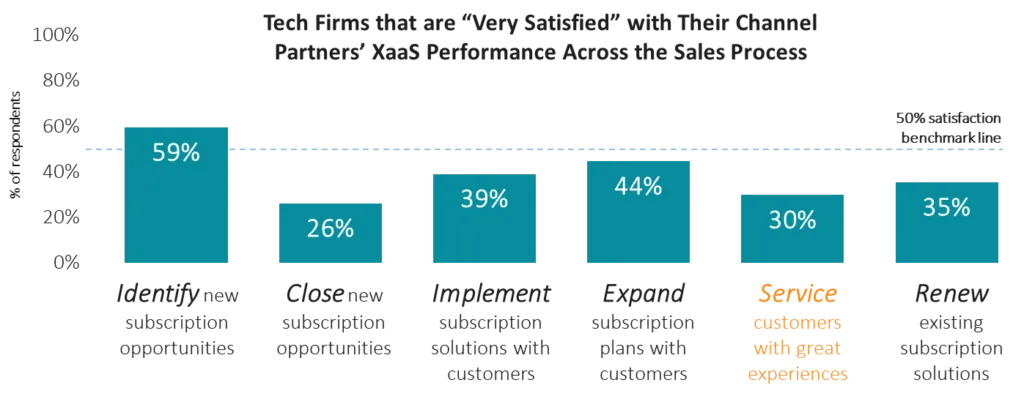
While many traditional partners have tried to enhance their customer service abilities, this transition has been slower and more challenging than businesses initially anticipated. As a result, partner performance has suffered, leading to dissatisfaction among tech firms with their partners’ capabilities throughout the sales process.

The Fix: Enable and Train “XaaS-Ready Channel Partners”

To tackle this challenge, companies should enhance partner skills in new delivery models and recruit and enable top XaaS-ready partners. Expectations also need to be clearly defined for each partner type. Along with training partners, setting thresholds of competencies/certifications, tracking performance against those expectations, and intervening on an ongoing basis can course-correct each partner and raise the performance bar for each and all.

3) Lack of Data-Driven Engagement Models

XaaS solutions generate an abundance of data, yet many partners lack the capabilities to use these new datasets to deliver value for customers. Businesses must aid partners in harnessing data, conducting analysis, and prescribing better experiences. With only 30% of respondents “very satisfied” with how XaaS partners service their customers with great experiences, honing in on the data and using it to build a better experience is a first start.

The Fix: Build an Always-On Insight Engine

With subscription and hardware-as-a-service solutions, businesses have access to individual and aggregated customer usage data that was previously unavailable. Companies can use these insights to prescribe to partners precisely what message to deliver to customers based on usage behavior, but they must first invest in building the data analytics solutions to extract that data. We call this an “always-on insight engine,” one that feeds actionable intelligence to specific partners in a conveyor belt fashion. A constant stream of actionable insights (“Hey, partner. Here’s what you can do now and why.”) will not only strengthen the vendor-partner relationship but drive incremental sales.

Overcome Challenges in the Race to XaaS Success

CROs must refresh channel strategies to outperform the competition. To deliver the predictable business outcomes and customer experiences needed for a winning subscription model, companies must focus on finding the right mix of partners, enhancing those partners’ skill sets, and leveraging customer usage data.

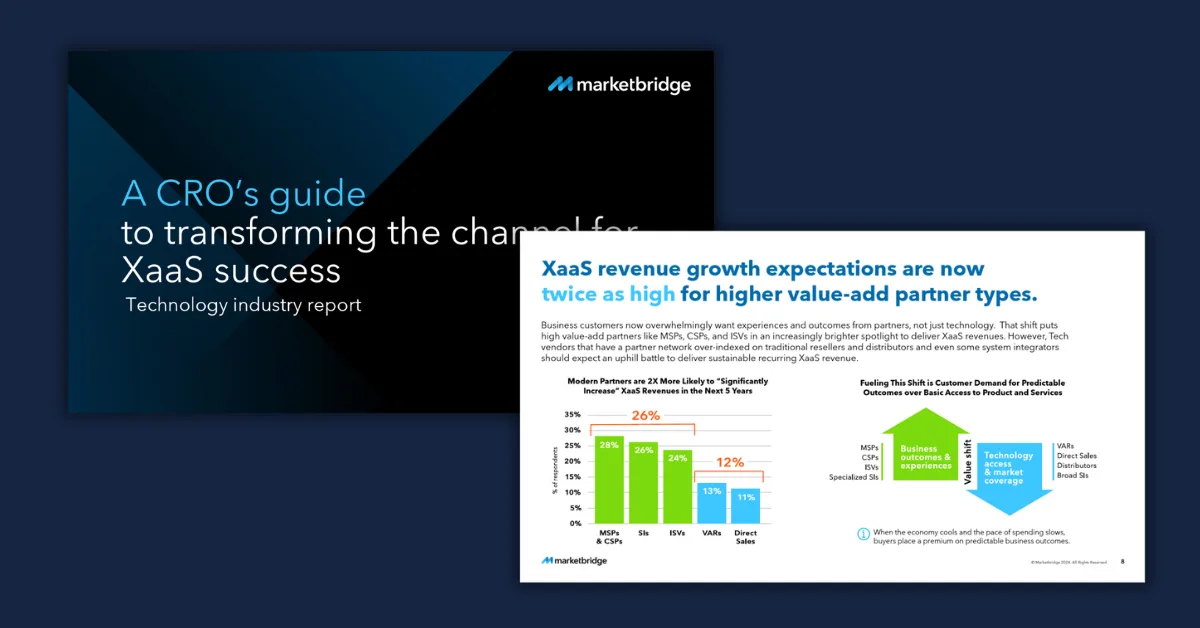
Download our report, “A CRO’s Guide to Transforming the Channel for XaaS Success.”​

In this report, built from quantitative benchmarks and interviews with industry leaders, we dive deeper into the challenges presented in this blog and provide a four-step path to move forward.

Surviving in a commoditized tech market

A commoditized market is often perceived as an industry’s endpoint. A cycle of early innovation leads to the emergence of market victors, an influx of new competitors, and, finally, a standardized consensus regarding industry solutions, from pricing to value propositions to products themselves. Characterized by stagnant growth and decreasing corporate profit margins, commoditized markets frequently result in reduced long-term growth investment and a prevailing ‘play it safe’ mentality. This includes commoditized tech markets.

Of late, the intertwining of market globalization and technological innovation has accelerated the journey toward commoditization in most industries. A striking illustration of this trend is a recent Innosight analysis indicating that the average lifespan of an S&P 500 company has decreased by about ten years since the 1970s. Competitive disruption, the proliferation of marketplace platforms, and the ease of access to information have conspired to make enduring success an elusive goal. While these trends have manifested themselves across diverse industries and market types, the consumer technology sector is often susceptible (broadly referencing consumer-focused devices/wearables, software/video games, etc.).

The Acceleration of Commoditization in Today’s Markets

Let’s take flat-screen TVs, for instance. The price compression seen in this market over the last decade is indicative of the commoditization phenomenon. With Consumer Price Index data from the U.S. Bureau of Labor Statistics, you’ll find that the annual CPI-based price inflation for TVs since 1950 in which the average rate has been -6.5% per year, and much more over the last 2 decades (with a recent trend change/adjustment during COVID years).

As technology rapidly advanced (and standardized), the production costs decreased, and competitors flooded the market, the end result has been downward pressure on prices (a fantastic result for consumers!). The technical aspects of different models have become less obvious to most consumers, and price has become the primary differentiating factor.

4 Strategies for Consistent Growth in a Commoditized Tech Market

Fundamentally, the potential market opportunity with consumers drives rapid innovation and competition. Differentiating and standing out from the crowd requires a consistent focus beyond short-term results. Four broad strategies exist for consumer tech companies to consistently grow share and revenue, though only one (the final listed below) exists directly within the domain of commercial organizations.

  1. Continue Product Innovation
    For most consumer tech markets, the competition increasingly comes from upstarts and from tangential categories. Product innovation is a must to ensure as certain markets become saturated, you are positioned to move into the next.
  2. Build Stronger Integrations with Solution Network Effects
    Connectedness drives the need for products to exist within broader ecosystems (whether company-specific or broader). Finding positive externality flywheels within these ecosystems can help lower acquisition costs and differentiate from companies that neglect them.
  3. Enhance Customer Experience
    Particularly for lower-priced consumer technology where switching or updating to the latest and greatest happens frequently, ensuring a post-purchase experience that is unrivaled in market can lead to successful revenue retention.
  4. Focus on Branding and Upper Funnel Marketing
    With the ability to influence and differentiate at the point of demand capture or sale diminished, consumer tech companies can enhance how they engage before the purchase cycles begin to have a subconscious leg-up when decision time comes.

The Significance of Upper Funnel Marketing in D2C Sales

For consumer technology companies that have shifted or increased their focus on direct-to-consumer (D2C) sales, the fourth strategy is of particular relevance. Many of these organizations have over-rotated towards demand capture marketing strategies such as search engine optimization, pay-per-click advertising, and targeted social media campaigns. This over-rotation has largely occurred because of the direct attribution that predominates; if a sale happens after a paid social click, it gets attributed directly. While these tactics are critical for capturing in-market buyers, they typically fail to create meaningful differentiation or foster brand loyalty as they operate on more short-term, rational decision-making like pricing or discounts.

This brings us to the crux of the matter: the need to invest more in the upper funnel of marketing strategies. It’s about shifting some focus back to awareness and demand creation. In other words, before winning the consumer’s dollars, businesses must first put themselves in a differentiated position.

Establishing emotional connections with potential customers is crucial in this regard. Emotional branding transcends the mundane considerations of features and price points to tap into the consumers’ aspirations, needs, and lifestyles. When brands succeed in doing so, they increase the likelihood that consumers will gravitate towards their product when they’re in the market, even in a commoditized market.

Going Beyond Product Differentiation in a Commoditized Tech Market

Indeed, differentiation in a commoditized tech market is not just about standing out. It’s about resonating with the consumers on a level that goes beyond the product itself. As the consumer technology market continues to evolve and commoditize, it’s those brands that understand and implement this concept that will truly differentiate themselves from the rest.

Only 35% of tech CROs and executives are very satisfied with partner performance

BETHESDA, Md., January 25, 2023 – As technology businesses increasingly rely on channel partners to cover market opportunities, sell solutions, and deliver value-add services to customers, Marketbridge’s new report shows that only 35% of Chief Revenue Officers (CROs) and executives are very satisfied with partner performance heading into 2023. The report, “A CRO’s Guide to Transforming the Channel for XaaS Success,” highlights the challenges and priorities in the channel as vendors push to develop and sell new as-a-service (XaaS) solutions in the face of an economic slowdown.

The shift to a subscription economy presents major go-to-market challenges for vendors. Technology vendors must upskill partners on new delivery models, recruit the best XaaS-ready partners, and convert brand-new buyer personas, all while enabling partners to deliver recurring business outcomes. The report’s findings, based on both quantitative benchmarks and interviews with industry leaders, provide a clear path forward for CROs to transform their partner channels for XaaS success.

According to the report, modern partners (MSPs, CSPs, SIs, ISVs) are two times more likely to ‘significantly increase’ XaaS revenues in the next five years. However, only 35% of respondents on average were ‘very satisfied’ with partner performance outside of initial opportunity identification. Executives were also three times more likely than managers to believe they are behind the competition in quantifying the right number and mix of partners to deliver target revenues.

Mike Kelleher, Senior Vice President of Marketbridge’s Technology Practice, said, “The channel is at a critical juncture. CROs must take a holistic view of their partners and focus on developing a modern, sustainable model that leverages the right mix of partners to drive growth in the subscription economy. This report provides a framework for partner transformation in 2023 and beyond.”

Access the report here.

A CRO’s guide to transforming the channel for XaaS success

A CRO’s guide to transforming the channel for XaaS success

Research and insights on optimizing channel strategy to outperform the competition

In facing an uncertain economic climate ahead, technology businesses are rethinking already complex routes-to-market and partner channels. Coupling uncertainty with the rapid progression to XaaS selling models, CROs are faced with a burning question,“How do I transform and future-proof my partner channels to drive efficient revenue growth in the subscription economy?”

Our analysis

In conducting both quantitative benchmarks and interviews with today’s fastest-growing technology leaders, we set out to highlight the challenges and priorities in 2023 and beyond. In addition, we present a clear path forward for CROs to transform their partner channels for XaaS success.

This report covers

  • The need for change accelerated by the uncertain economic climate
  • The value pivot occurring in the channel
  • Direct-from-the-source challenges and priorities heard from tech executives
  • Four steps to building a modern partner model

Select insights

  • Modern partners (MSPs, CSPs, SIs, ISVs) are 2X more likely to ‘Significantly Increase’ XaaS revenues in the next 5 years
  • Only 35% of respondents on average were ‘very satisfied’ with partner performance outside of initial opportunity identification
  • Executives are 3X more likely than managers to believe they are behind the competition in quantifying the right number/mix of partners to deliver target revenues

What’s next?

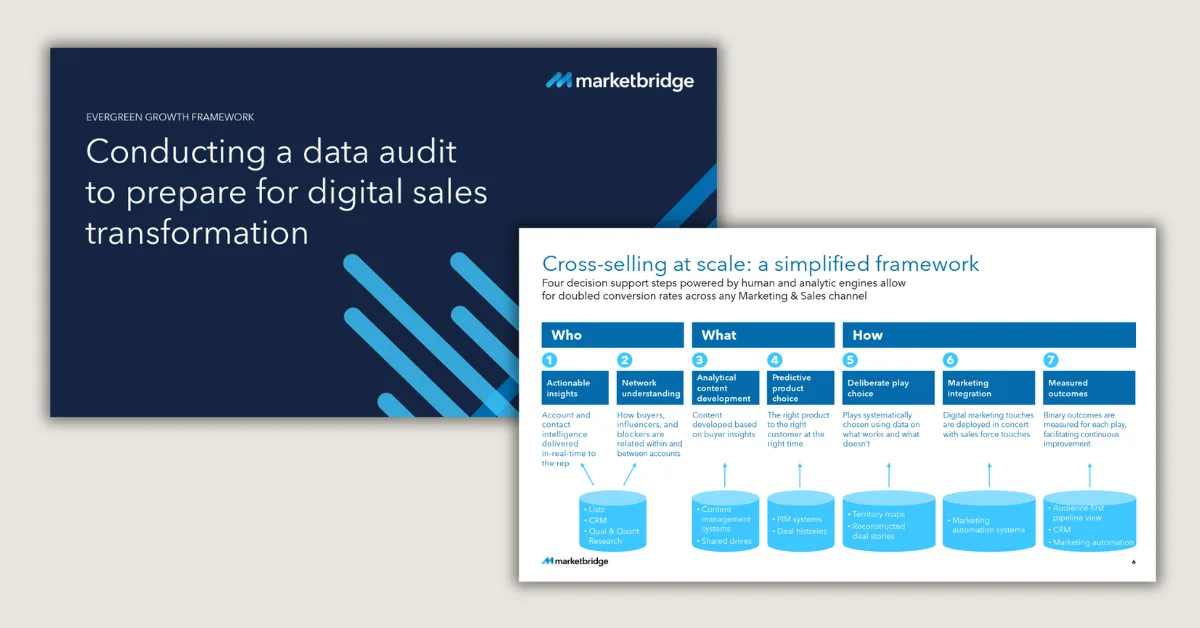
Conducting a data audit to prepare for digital sales transformation

Conducting a data audit to prepare for digital sales transformation

A digitally transformed sales force has seven key traits across “who”, “what”, and “why” data

Digital transformation is a critical topic for most commercial leaders. However, there is a common misconception that digital transformation is largely about picking the right software. In reality, it is much more than that and requires a strong foundational understanding of data and data sources. This foundational data understanding can ultimately make or break your transition to systematic sales decision-making.

Download the framework for seven key traits and get nine actionable tasks to help you prepare for digital sales transformation.